
Head, Heart, and Soul with Daniel Maldonado
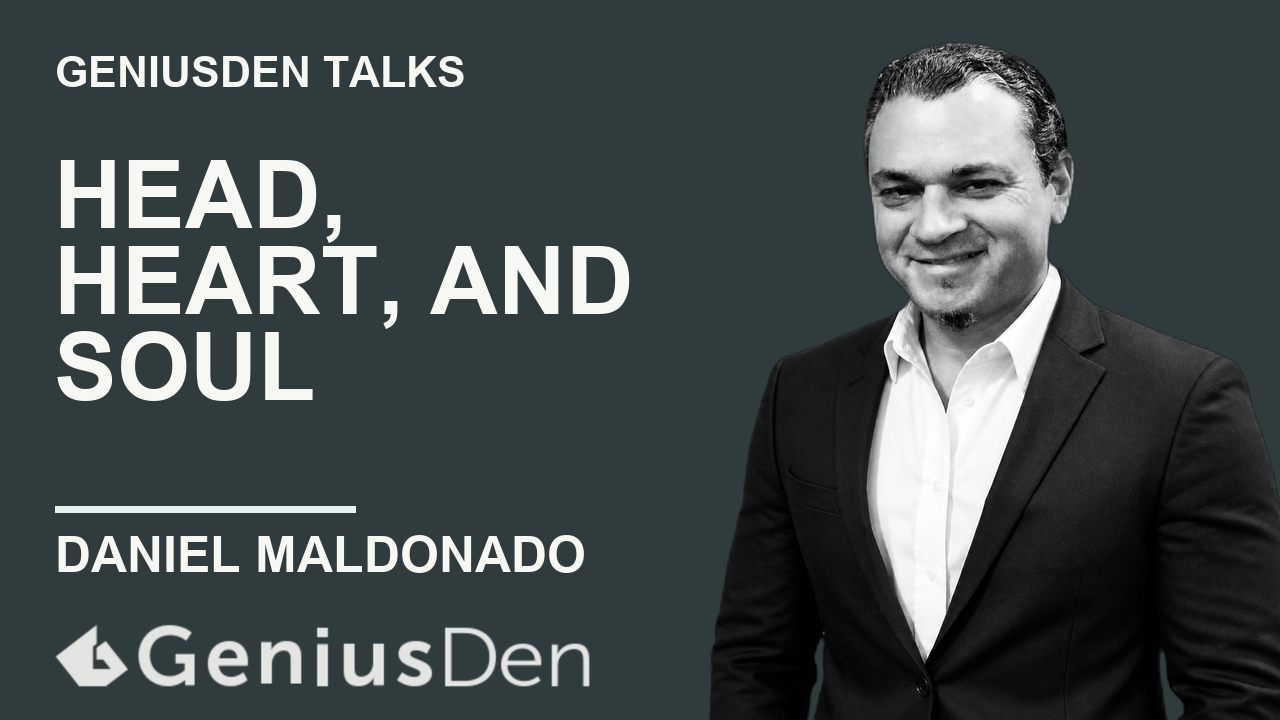
Video scheduled for October 2, 2026 at 10:00 AM Central. The presentation is not available to play yet.
Presentation excerpt15 min
What you will learn
About this presentation
Explore an experiential approach to emotional awareness and authentic leadership. Daniel Maldonado introduces a shared language for anger, sadness, fear, shame, and joy; shows how feedback can expose blind spots; and uses archetypal roles to help participants recognize the energy they bring to a room.
Why this speaker
About Daniel Maldonado
Daniel Maldonado is a facilitator whose GeniusDen session draws on vulnerability practice, emotional-awareness models, participant feedback, and Jungian archetypes. He presents these tools as a way for leaders and communities to recognize blind spots and respond more authentically.
Presentation transcript
Read transcript
A transcript synchronized to the corrected presentation has been conservatively checked against the recording; uncertain wording is left conservative or marked rather than guessed.
Source: GeniusDen archive transcript checked against the recording. Administrative opening and closing material is omitted; the presentation wording is otherwise preserved with light readability edits.
The experience, you know, a very difficult experience, will be bettered by how honestly and authentically people participate, which means that even if you don't participate in an outward way or come up and volunteer—and you won't be forced to volunteer—then you can actually participate by not volunteering, in a way, by just observing and holding space and just opening your heart so that something amazing can happen here tonight. That's the distinction with being. It doesn't happen all the time, but with the technology we have, it can happen more often. So there's one ground rule that I want to repeat, and that is the word “ouch.” So as a facilitator, I still have blind spots. I still have clay feet, I'm part dinosaur, I'm still evolving—a work in progress.
So if I say something that's offensive or triggers someone, you can say “ouch” as a, “Hey, I didn't like that,” or, “I felt it,” and then if it's big enough you can take a moment to process it and look at it, and then move on. But it's one of the things that I love about Mankind Project and other vulnerability models for leadership, is that on an ongoing basis I look at impacts, and I can only do that if people feed that back to me. So can I get a “ho”? Ho. Okay. So before we get started, there's a short teaching piece that I want to do, and if you don't remember, that's okay. But there's four or five major food groups of emotions that I'll be asking you to access or be aware of or witness inside yourself.
That's mad, sad, glad, scared, or shame. Shame has two sides to it. There's the shame: I did something wrong. Okay, it was bad behavior. I made a mistake. And then there's the toxic shame where, oh, I feel really low and feel really little because I did something. So that's one of the things that I've had to learn how to navigate—the shame part—because with the kind of shame I had, I would have never been able to get up and facilitate a circle like this. If I would have said something wrong with an “ouch,” I would have felt little, like, I'm never going to do it again. Anybody ever have an experience like that, public speaking? It's like, wow, a human being that's shaking like that or fearful like that.
There's a piece of gold, a contribution that that person could bring into the community. And so that's the way I was. I was withheld. A bunch of men came—I came into this community, men came into my life—and they helped me dig in and find that gold and express it more confidently, more authentically. So the five major food groups, and then the four archetypes: Lover, King, Warrior, and Magician. And that's an archetypal model that comes from Jung. And Jung, Robert Moore, Robert Bly, to some extent, taught that all men and women are hardwired with archetypal energies. So the sovereign, being a queen or a king. And sometimes I'll step into my king and I'll just [unclear]. Other times I'll open up my heart and I'll listen to you.
Other times it's the Warrior: get stuff done. Or the Magician, which is spiritual and looking at reflection, looking at [unclear]. So I want y'all to bring these archetypal energies and participate. [unclear] is welcome here. And then what we're going to do here is have a hero's journey. Anybody know about the hero's journey? Raise your hand. Joseph Campbell's hero's journey. There is a piece around the hero's journey. [unclear]. So the hero's journey follows a very simple pattern: separation, and then a descent. And we've already separated from that world out there and we've come into this space.
We're going to go down into a space we may not usually go to with people we don't know very well, or places I may not go to very often. And then we're going to have some kind of an ordeal. We're going to look at something together that maybe, as human beings on our planet, in our country, in the world, there's some things—maybe do we need to be looking at some stuff in community? Yes or no? Yes. Okay, so we get some agreement there. And then we'll come back and we'll, you know, finish up, and we'll go back out. We'll do this within about an hour, 45 minutes. So any questions? Any ouches yet? Anybody want to add something?
Mm-hmm. Okay. Is that what we're saying? Yes. Okay, so Daniel, at some point I would really like to see all the brothers that are already in Mankind Project raise their hands. Would you like us to do that now? Would all the Mankind Project brothers raise their hands so that the guests can see who is and is not already in? So every man that's raised his hand has attended a New Warrior Training Adventure and had a hero's journey weekend retreat with other men. Yeah. So if you have any questions, we would be the guys to talk to. Is that fair? Yes. All right. Thank you for that. Thank you. That's an environment of contribution and participation. So we're going to create a human sculpture.
We're not going to be all piled up. We're going to have some chairs out here. We're going to construct it. We're going to deconstruct it. It's going to fit. It's going to hit on all those things that I mentioned. So my first invitation is to someone who's feeling really juicy, innocent, pure, golden, maybe like the innocence and purity of a child. So is there somebody in the circle tonight that has that kind of pure, childlike energy? We'd like [unclear] to our circle tonight. [unclear]. Oh, you just had a birthday? So this kid right here just had a birthday.
Happy birthday to you. Happy birthday to you. Happy birthday to you. Happy birthday to you. Open up a little bit. Come this way. [unclear]. Can you scoot back? [unclear]. All right, that's good right there. So your role is to be in that happy, golden place. You can do that, right? Yeah, so just see that in him. Can you see that over here? Even though he's been on the planet a few decades, [unclear] that innocent period. So if you think about a child, if you think about that innocence inside yourself, what are the names that you would describe that?
Explain them. Speak them out. Sweet. Loving. Innocent. Curious. Adventurous. Fun. So this is the way we came into the planet, most of us. And then you'd be playing, and you'd be playing and having a wonderful time, and perhaps you'd get the markers and you'd go into that living-room wall, and you'd see how fire is, you'd burn something down, or [unclear], and you'd want to show them at the party. And then you'd find something else, and you'd show up at the party with all the adults. What might happen? No. Stop it. Stop it. Bad. Bad. So as we go through this human sculpture, [unclear].
Even the best of families. How many families are dysfunctional? [unclear]. What I'll say is that we all have a wound. So I want to invite somebody to play the wounded child. And before you choose to participate in that, I would want you to go in there and drop down to a place where you were wounded horribly or [unclear]. But just hold this space for tonight as a wounded little boy or a little girl. Who's willing to hold that space for the circle tonight? Is that you? All right, so just get your chair out. And Carl, you just stay who you are in your goldenness. And David, if you'll just maybe take on a posture that's not too uncomfortable with woundedness.
Maybe a word or two about how you remember being wounded when you were little. I did something wrong. Something wrong. Perhaps [unclear]. What are the kinds of woundings that we have as children? Yelled at. What else? Spanked. Ignored. Embarrassed. Humiliated. Threatened. So if a child comes into the world this way and something happens, maybe he covers it up, she covers it up. What emotion might come from a wounded little person in a world of big people? Shame. Shame comes, yeah. Something's wrong with me. Badness. Fear. Anger. Sadness. [unclear] will definitely show up. So the sadness that's here will give way to fear. So is there anyone who knows fear?
Nail-biting fear. Anxiety fear. Driven by fear. I'm a workaholic, and [unclear]. Is that you, Bob? Okay. Fear. Fear. That would be me. All right. So y'all want to wrestle over this, or, Terry, you're up for fear? You win. Okay. Okay, so see what happens is that some kind of big sadness happens. It goes somewhere. Maybe the kid's still playing, but there's this little ball of sadness somewhere. And then fear shows up. So you can just take on the posture of fear without being too uncomfortable. And let's just go around in a circle and say a few things you're afraid of. All right. IRS. Criticism. Being alone. Failure. Thank you.
Rejection. Abandonment. [unclear]. Success. Shame. Failure. [unclear]. Success. The list goes on. Okay, so we all have fears. It's not unique. Whatever fears I might have, I don't have to suffer terminal uniqueness, because other human beings have them. So if you were [unclear] this way—how are you doing back here? Juicy. All right—you were [unclear] this way, but this happened, and this is dominant. So you have sadness and fear as being a dominant emotion. What emotion might come from that? Anger? Not anger. Depression. Depression? Yeah, there'd be depression.
[unclear]. That's anger. [unclear]. Criticism. So that anger is going to kick in. Why will the anger kick in? Defense. Confusion. Not fair. Not fair. It's a reaction, right? It would be a form of protection. There's a poem by Casey LeClaire that said, “If you see an angry man, hug him because he's crying.” So, got any really badasses or tough, angry women in the room that want to be in a place of anger? [unclear] if you have anger and want to be angry. So, for the ladies or a man who wants to be in the role of the angry child.
Old anger. [unclear]. Who is that? All right. [unclear].
Hosted at GeniusDen, a business work and meeting space in Deep Ellum, Dallas.