
Mexico at a Crossroads with Gabriel Guerra Castellanos
Full presentation1 hr 4 min
More videos (1)
What you will learn
About this presentation
Gain an informed view of Mexico's political and business climate at a consequential point in the Peña Nieto administration. Gabriel Guerra Castellanos connects domestic institutions, reform, public opinion, security, and the North American relationship to implications for leaders and investors.
Why this speaker
About Gabriel Guerra Castellanos
Gabriel Guerra Castellanos is a Mexican political analyst, strategic-communications consultant, and former diplomat. His public service included cultural and press assignments in the Soviet Union and Germany, service as Mexico's consul general in Toronto, and leadership of international information for the Mexican presidency.
Event resources
Event resources
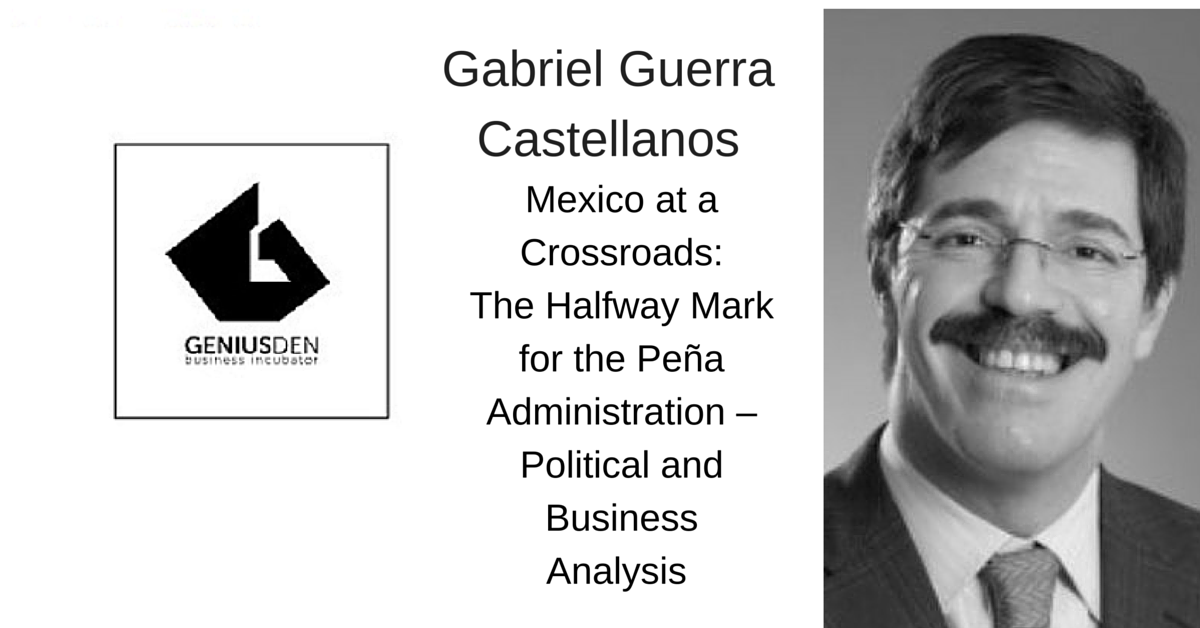
From the GeniusDen archive
Original event promotion
An insider's look at Mexico at the halfway mark of the Peña administration, its political and business climate, and what lies ahead for Mexico, its people, and the North American relationship.
Original GeniusDen Facebook advertisement. Preserved as historical event material.Presentation transcript
Read transcript
A supplied human transcript has been conservatively checked against the recording; uncertain wording is marked rather than guessed.
Source: GeniusDen archive transcript checked against the recording. Administrative opening and closing material is omitted; the presentation wording is otherwise preserved with light readability edits.
A lot of people say that the Mexican government and the Peña administration are a mess and a disaster and that everything that could possibly go wrong is going wrong. They might have a point in that, yes, there are many things that are complicated and not going the way anyone would expect or anyone would want right now. I always find it useful to give a little bit of perspective to things. I remember when talking about President Calderón 9 years ago, 10 years ago, and people criticizing whatever he may or may not have done. I would say bear in mind that in late November 2006, just before his inauguration, we did not know whether President Calderón was going to be able to take office because of the fractiousness in Congress. It was not a given that we would have an orderly oath of office and therefore a constitutional president in 2006.
It’s good to remember those things when you're grading governments or administrations afterwards to see where they started and where they came from. Where the Peña administration began since the campaign and during and right after the elections was with very low expectations. People thought of Enrique Peña as a very charismatic, very handsome, good looking, old fashion-styled politician who would be, as we say in Mexico, more form than substance, more good looks, more marketing strategy, more script, less politics to it. And oh, surprise, in those five or six months, which is an eternal transition between election day and taking office, I don't know why we do that in Mexico, but in this case, somebody did their homework and they managed to push forward what has been I think a landmark in the last quarter century in Mexico, which was the Pacto por México.
The Pacto por México was basically an agreement between the three main political parties … a couple of other ones tagged on at the end but that was not really relevant … on getting what we call the structural reforms: energy reform, telecommunications reform, education reform, financial reform, fiscal reform that everyone may or may not agree with the substance and the content of those reforms but which were, again, for a quarter century, what everybody was pining for eternally. I remember since the mid-‘90s listening once and again and again and again in every conference, in every talk about Mexico and every article you read, you would hear or read if only we could get the structural reforms through then this would be a different country. I don't know about that, but I do know that thanks to the Pacto por México, we won’t have to listen to that for at least 20 years. That’s a big relief.
Mexico became suddenly everybody’s darling. Even since before the inauguration, The Economist had a cover, a very famous cover, titled, The Rise of Mexico. Then, the Financial Times in a major zoological mistake called us the Mexican Tiger. There are no tigers in Mexico, except in the zoos. Anyway, I did mention to the correspondent at the time, this was the jaguar and not the tiger. Even Tom Friedman said that Mexico was the place to look at. Definitely, all political expectations were exceeded and all this talk about it, all being show and no substance was also off the board.
However, the economy never quite took off. Not to quote James Carville, but at the end of the day, that is what many people grade things on. Saving Mexico was still the big story. I don't know what the Time editors … First of all, I don't know how relevant … I have fond memories of Time magazine. I don't know whether it continues to be what it used to be. I’m afraid not so much, which was face-saving for them. That is not a cover that anyone would relish given everything that’s happened.
Again, despite a lot of very important announcements, the Mexico City Airport which will be a huge project, a new concept for a national security strategy, a new program to fight poverty, at the end of the day, the economy failing to take off, fiscal reform, tax reform hitting the middle and upper middle classes especially hard, and of course the well to do, which is in a country like Mexico what you would expect a fiscal reform to do. A country that has … I’ll talk more about poverty later, but a country that has 52, 53% of population living in poverty. You can’t really expect the tax reform that doesn’t tax the wealthy … Anyway, it was highly unpopular.
After that came, almost like in a perfectly scripted soap opera, everything suddenly collapsed and everything began to collapse with the drama of Ayotzinapa. I’m sure I don’t need to go into too many details. Everybody here is aware of what happened to the 43 students. It was a tragedy. It was one of the most horrendous things we’ve seen. Even though some people argue numbers-wise, worse things have happened in Mexico, these were however students, and these were students hoping to become teachers. The country cannot let 43 future teachers, no matter what you think of their politics, of their ideology of what they do, they just can’t let them disappear like that and they can’t let something like that happen to them.
The big problem was not so much that it of course was terrible that it happened, but that the government took so long, the federal government, to realize how important this was. It let it languish for a couple of weeks in the hands of a notoriously corrupt state government and even worse, municipal government which was basically responsible for what happened. It became the beginning of a downfall for the Peña administration.
After that, imagine a play at the theater where everything has been going flowingly and the lead character knows all his lines perfectly, and then suddenly he stumbles. I don't know if anybody here is a fan of the theater. If you are, you will see sometimes an actor stumble, forget a line, miss his spot, miss his cue, and then you have great actors who are able to catch up, improvise along the way and improve upon it. You have so-so actors who manage to get back into play somehow. Then, you have actors who get lost and who continue to be lost for the rest of the play. At least for a year, this is what happened.
Everything after Ayotzinapa became an example of late reactions, bad political instinct and very poor communication. This is something I’ve said publicly in Mexico and I’ve said to their faces. It’s no secret that this administration suddenly lost its bearings and is now trying to recover. The White House case, the whole conflict of interest discussion, El Chapo’s escape which will make at least for a great movie someday, including the latest foiled capture attempt.
With all of these of course came a decline in the president’s popularity. Depending on which polls you look at, this is Pew research, 72% of Mexicans are dissatisfied with the way things are going in the country. I’m surprised it’s not 99 because we Mexicans tend to be very critical of everything. We tend to be a little bit more critical. I get a lot of flak sometimes from our multinational clients who operate in Mexico. When I give them an assessment of something, it’s not infrequent that they tell me, “You guys are missing the big picture. You guys are worrying about all the little details.” Well, at the end of the day, it’s the country we live in and the country we want our children to grow up in.
Anyway, President Peña is less popular in his third year than President Calderón was at the end of his famously controversial administration. Having said that, look at the approval ratings for other presidents in Latin America and then he’s almost a rock star, but that’s another story. Dilma Rousseff throws a party when she gets double digits in the approval ratings, and I’m not exaggerating.
This is another poll from El Universal/Buendía & Laredo. Again, end of August. The red is in this case the wrong direction that the country is going in, and the approval ratings are there below. We can email this to anyone who’s interested at the end if you just leave your cards with Ana Paula, your credit card information, your banking information and the name of your spouse and your firstborn. Now this is Reforma. Basically everything going wrong in the polls.
This is an interesting one because this shows the level of confidence in Mexican institutions. First of all, it’s relevant because it goes beyond politics or beyond party politics. Second, because it is a yearly … Consulta Mitofsky does this poll regularly. It shows you who is improving, who is getting worse? Blue is 2012. Red is ‘13 and green is ‘14. You will see at the top of the confidence meter the army, and that’s interesting because traditionally in Mexico, the army has played a noncombat role, as those of you who know Mexico are aware. In the last six, seven years, it has been very active. In second place, universities. In third place, the church. It always used to be the church in first place, so scandals have definitely had an impact there.
Then, I love this, the media, meaning print, then radio and then television. Why do I love this? Because everyone in Mexico says you can’t trust the media. You can’t believe a thing you read, hear or listen to in the media. Yet, they rank higher than the National Elections Institute. They rank higher than businessmen. They rank higher than the Supreme Court.
Way at the end, this will be no surprise, the unions, then congressmen and then the political parties. All of those rank, including senators, below the police. That is really saying something in Mexico.
What are the good and what are the bad so far? As I said, Pacto por México, the 12 structural reforms … Education reform, which was arguably the most complicated of all the reforms and the one that held the most difficulties in terms of implementation, what the government has done so far is pretty amazing in terms of weakening the two unions that were holding back education. I’ll tell you this as someone who in my youth believed in unions, and unfortunately Mexico is a textbook example of how unions can go wrong in so many terrible ways, but a lot of progress in education reform will take a long time.
Macro stability is very impressive. There are no … In spite of the peso devaluation and in spite of everything, the slow economic growth, whatever, the fundamentals are pretty good. Small decrease in unemployment, which points a little bit to growth and a lot to formalizing workers. Many workers who were off the books or many workers who were not getting social insurance benefits now are.
Then, I go over to the wrongs. Of course, El Chapo. Of course, the White House, Ayotzinapa, an increase in poverty and inequality. I’ll address that in a minute. You’ll notice I have put both on the plus and on the minus side weak economic growth and the exchange rate. Why. Because, yes, we’re having very weak economic growth but much better than most countries in Latin America and other parts of the world.
The exchange rate because (a) even though it’s been about a 25% drop, it has not affected inflation. We’re having historically low inflation levels right now. It’s been managed in such a way that, yes, it’s created a lot of disgruntled travelers. The people who complained the most are those people who usually come here to shop or want to go to Europe or whatever. Most companies are not hurting terribly. It’s been relatively well-managed. Of course, a lot of challenges ahead in terms of accountability, transparency, security, rule of law, but I’ll get into some of that in a minute.
There were 10 major announcements. I’ll go over this very quickly. In the third informe which was the official launch of the second half of the administration, probably laws to fight crime, corruption, improve transparency and rendición de cuentas, as we call it, accountability, are very important. Bonds for educational infrastructure are very important. New financial instruments. Basically, this is to keep investment flowing into public works without greater debt.
Surprise. Elections arrive with slow growth, with the peso plummeting, with the president’s approval ratings in the doldrums. You would say obviously, the opposition wins, right? No. Surprise. The PRI held its majority. We had three new political parties participating. One of them, Mr. López Obrador and Morena. You had two parties lose their registration.
Most significant of the midterms, the entry into the scenario of independent candidates, nonparty candidates; one of them won the governorship of Nuevo León. He’s the one who’s made the most headlines. He’s also the one who’s the least independent. We can get into that in the Q&A session. This is a guy who was in the PRI for 30 years, left, disgruntled, because he did not get the nomination he wanted at the time, and then won the election with the backing of all the major business groups and the major media outlet of Nuevo León. Call me cynical, but that doesn’t really sound independent to me. Well, establishment.
This is how it used to look. This is how it now looks. Yes, the PRI lost 11 seats, but so did the PAN, and so did the PRD and they lost even more. The Green Party which is green, I think they’re thinking in dollar terms, not in environmental terms, they won very big. At the end of the day, the PRI had already achieved and President Peña had already achieved everything he really needed a big majority in congress for, which were constitutional reforms. Now he just needs a 50% plus 1 to get his budgets passed, but essentially, all the heavy lifting in the congress was done at the beginning of the administration which I think was a very smart strategy because after the first half of the Peña administration in Mexico, you can’t get anything through in the congress.
This is turnout. Again, you would have thought people are upset, people are cynical, so either they’re going to turn out in droves and vote the government out or they’re going to all stay home. They didn’t either. The dips you see here are the midterms. Usually less people vote in the midterms. I think the same happens in the US. Higher turnout in 2015 than in 2009. Evidently, something is not going according to the pundits.
This is how the states look. I don't know what this thing with the color purple is, but anyway, that’s supposed to mean independent. Other than that, blue is PAN, red is PRI, yellow is PRD. Nothing dramatic changed, but if anything, the PRI was able to maintain most of its positions and win a very important one in the state of Sonora.
This will be next year. Next year, we have 13 governorships up for grabs, literally up for grabs when you look at the list of people trying to become governors. It shows we are so, so democratic now that literally anyone, it’s almost like Washington, literally anyone can run for governor or president or what have you. I know I’m in Texas. I’m going to be very careful with everything I say.
Again, at the end of the day, it’s all about the economy. The one thing I cannot wrap my head around is why are we consistently missing expectations? Every time you have an estimate of growth, whether it’s the World Bank, whether it’s the Bank of Mexico, whether it’s OECD, whether it’s the Ministry of Finance, they are adjusted. It makes it very complicated for people like me who speak in public or give talks like this because I was wondering, my god, do I have to write graph this time around or did I miss one? I’m going to start numbering them or putting a date on them. Anyway, I think if we end up slightly above 2% growth this year, we’ll be lucky.
Again, as I was telling you a minute ago, these are Cepal’s growth expectations for the region. The average for the region this year is 0.5%. If Mexico were to clock 2%, even 1.8%, we would be 3.5 to 4 times above the regional average. With the exception of Colombia, Peru and Panama, but Panama is difficult to use as a standard, everybody else is … Brazil is decreasing. Argentina, nobody believes their numbers with all due respect. I don't know if there are any Argentinians in the room. If there are any Argentinians, please tell me, then I’ll say you're growing 10%. It’ll be the same. Nobody will believe me anyway.
This is how the economy has been behaving. Again, very poor 2013, slightly better ‘14, and then an up and down-ish ‘15 so far. The main thing here is it’s remained stable and inflation is ridiculously low. In the month of Sept, the forecasts are for the lowest recorded inflation in Mexico since we started measuring, which is not a bad thing. We used to have 2.5% inflation in a week. This is the yearly accumulated. That’s a pretty good thing.
Positive debt ratings. I won’t bore you with that. Peso is starting to stabilize again. A lot of people make a lot of noise about the decline of the peso. I am not one of them because everybody was complaining a year, a year and a half ago about the peso being too strong. I think we’re finally getting to where we should be.
Of course, one of our big challenges is competitiveness. We are still very bureaucratic, very complicated. When I think of what we’ve had to do to set up an office here to incorporate, to get our tax ID number, our banking and so on, it’s been a breeze. Not that Ana Paula is in any way not masterful, but it’s been very simple. In Mexico, it’s terribly complicated. For god’s sake, you have to go to the Ministry of Foreign Affairs to make sure that the name you want to register is not already registered somewhere … I was going to say Saudi Arabia, but I’ll skip Saudi Arabia because our new counsel just arrived from Riyadh. You’ll tell us later which one is a hardship post, whether Riyadh or Dallas. Anyway, we are 61st according to the Global Competitiveness Index.
We have a big issue with poverty. This is a big deal because at the end of the day, no matter how you measure … and Mexico has set the bar very high. This is something that’s probably worth remembering when you talk about this. By Mexican standards, if Brazil were to use the same standards for defining poverty as Mexico does, Brazil would have 25 or 30 million more people living in poverty. We have set the bar very high. Still, to have a country like Mexico with about half of the population living just at or below the poverty line and having 11.5 million people living in extreme poverty is just absolutely unacceptable socially, economically, ethically, just about any way you can be.
It’s a very complicated issue. I’ve been dabbling in it recently a little bit to understand a little bit more. Basically, what that shows you is that not only has poverty increased but also the number of people who are just on the threshold has increased, and that’s obviously not good news.
Doing business in Mexico. Well, everything is relative as they say. Thirty-nine out of 190 is not exactly great and where we want to be, yet people do business with Mexico. People invest. People create jobs. Mexican entrepreneurs continue to do things. We are not branching out because of anything other than the fact that we’ve essentially exhausted our growth possibilities in Mexico because we have a very strict non-conflict of interest policy so we can’t work for our competitors. We’ve been lucky enough, and I touch wood, that we work for major players in most industries. If you work with Pepsi, you can’t work with Coke. My god, please tell me we’re serving Pepsi here.
Anyway, lots of free trade agreements. If we devoted a tenth of the energy we devote to free trade agreements to getting people out of poverty in Mexico, we would probably equal the markets that we are currently dealing with. This is where foreign investment comes from to Mexico. US is the blue; obviously a key player. Where does it go? Just about everywhere, including professional services, business services, mining, and of course now a lot going to energy.
We have a very complicated relationship with the US. Some would say we’re blessed. Some will say we’re damned by or cursed by history. My parents were diplomats, and I lived as a child in Israel. My mother mentioned to an Israeli politician one day this old saying about … They attribute it to Porfirio Díaz … Poor Mexico. So far from god and so close to the United States. The Israeli said, “Madame Ambassador, we say it exactly the other way around here. We say poor Israel. So close to god and so far from the United States.” I guess everything is relative. We have lots of opportunities. We have lots of issues.
I personally have a big concern. I think everybody should be free to elect whoever they choose, but the fact that the leading candidate for the Republican Party is having such an aggressively anti-immigrant and anti-Latino rhetoric. It’s not that it worries me that it will become government policy. I still have hopes for common sense and decency in the voters. What worries me is that it becomes politically and socially acceptable to say these things. What Trump is saying is what many people were thinking but did not say out loud because it was rude, because it was politically incorrect, because it was insensitive, because what have you, nonsensical as well.
Now you have a character who is leading the Republican polls, who’s on television every day saying these things so suddenly, the closet racist, the closet discriminatory person feels he can actually go out and say it. He can actually go out and do something about it, and do something about it usually means discriminate, mistreat or attack. That is what concerns me the most about Mr. Trump and the radical anti-immigrant wing of the Republican Party.
Finally, and I close with this, these are obstacles and opportunity. Mexico needs to strengthen rule of law, needs to fight corruption. There’s no way you can strengthen Mexican institutions and get more people to trust them if corruption is continued to be seen as a driving force in Mexico. Education … and of course, if we get the US economy growing rapidly again, that will provide a major boost. What are our obstacles? Violence and public security. That is not going away any time soon and it would be unrealistic to think it can go away. We let it grow and fester for too long. I’m not going to get into the discussion. I’m sure you're all familiar with it.
Who is really at fault, the consumers or the suppliers or the transit countries? Everybody is at fault at the end of the day. I think it’s hypocritical for any country to say it’s their problem. The fact of the matter is we let it grow to this extent, just like the Colombians did. I’m sorry, but the Colombians, they have been very good at managing the perception of the problem, but Colombia today has a violent murder rate that is about 45% higher than Mexico’s. If anybody tells you they’ve solved that, sorry, they haven’t. They’ve just handled it very well from a communications and media perspective. It’s good for them. They have been able to change perceptions, but the reality is still there and that’s going to be an issue in Mexico for many years.
With that, I thank you very much. I hope … I don't know how we are for time, but if you have any questions, comments, I’ll be more than happy to try to answer it. Please.
On demographics, population growth is now below 2% which is a dramatic improvement over what used to be 3.8, 3.9% back in the mid, late ‘70s. Mexico did institute I think very proactive policies in terms of education for everyone, about birth control, about not having too many children and so on. Continues to be an issue of the poor families having more children of course, but we’re going to be facing a bit of a problem 20 years from now because our pyramid is no longer going to be the big youth surge that we have right now. Maybe 20 years from now, we’ll be having to listen to a Mexican Donald Trump complaining about Hondurans and Salvadorans and Guatemalans, and that’s unfortunately the way history works.
The church is probably less radical today on both ends. You don’t have the very active liberation theology priests which were highly visible, and probably the latest example of that was Samuel Ruiz in Chiapas, but you also don’t have the most senior heads of the church being as radically conservative as somewhere in the past. I think the church has tended to diminish its extremes if you would. It doesn’t play as important a role as it used to in Mexican public life. You saw the graph. Their prestige, their reputation has diminished. All the scandals are not for nothing.
This pope is a bit of a toss-up. I mean he’s not Wojtyla who was a big fan of Mexico and everybody adored him. I say this in all earnestness. We may make jokes about Argentinians but they’re not really jokes. They’re anecdotes. There’s something there. Pope Francis doesn’t seem to especially like Mexico. He’s taken a long time and finally deciding to visit Mexico. The fact that he was here and did not make a brief visit to our north I think was very telling in that sense. His excuse that he couldn’t go to Mexico without visiting the Virgin of Guadalupe, I don’t think it’s a serious comment.
The other challenge for the church in Mexico is the dramatic growth of other denominations. That is moving along very quickly, gaining ground. There are all kinds of denominations. There are some that are very radical, if you would, or very extreme in their views. Many emphasize hard work, no drinking, and that holds an appeal, especially for women in poorer parts of the country who want their husbands to abide by that. It’s been a radical change just about everywhere.
In our office, we have the janitor, handyman, night watchman, what have you, is an active Christian. He would proselytize. We finally convinced him that it was not a good idea to proselytize, especially to young female professionals whom he told that they really should be at home educating their children, which they did not yet have. Anyway, it becomes more and more present every day. The Catholic Church is not what it used to be. I hope I answered your question. Please, back there and then you.
A house that the First Lady bought on credit. Are you familiar with that? It’s called the Casa Blanca in Mexico because it’s a huge house and it happens to be white.
I don’t think there is any data yet, then again, it’s relatively soon to talk about that. I’m sorry. The question was whether the legalization of marijuana in some states in the US has affected revenues for the drug cartels in Mexico. There’s no evidence of it yet. I don’t think marijuana is … It probably makes for a lot of bulk in terms of trafficking. I don’t think it necessarily makes for the most profits or for the most amounts of money. If you ask me, I think that is probably … In Mexico, in the US and in other countries, marijuana makes the bulk of everything. It makes the bulk kilo-wise. It makes the bulk of arrests, of raids and of people in jail. It’s an oxymoron at the end of the day. How many resources are devoted and how much jail space is devoted to people who are dabbling in something that many states and many countries now consider if not legal then at least something that should be tolerated. That’s a whole other discussion.
The one thing I do know is no matter where you stand on legalization of drugs, the recipe that has been in place for the last 50, 60 years clearly does not work. It’s not a question of whether drugs should be legal or not. It’s a question of whatever we are all collectively doing right now is a sham. It’s a disgrace because it doesn’t work in any way and it does harm to an incredible amount of people.
Yes, it has to do with education in Mexico. The huge number of people that don’t receive adequate education, whether anything is being done to address that or is there a change of mindset. Did I translate your … I think yes, there is. Education reform … Again, all these reforms were passed by the three major parties. This is not touting anyone in particular or I’m not banging on anyone’s drum. It is the first time in 25 years that anybody has dared to touch the unions.
One leading union that was headed by Elba Esther Gordillo, you may or may not have heard of, she was the most powerful woman in Mexico. She headed a union comprising 1.2 million school teachers; largest union in Latin America, very politicized union. She was responsible for Felipe Calderón winning the 2006 election because she founded a political party and she instructed and got about 80% of her voters to follow her instructions which were vote for our guys for congress but vote PAN and Calderón for the presidency. That is the exact difference in votes that Calderón or the PAN had for the president and for congress, about 500,000, 600,000. Without that, Calderón would not have won.
You had an offshoot of the union known as La Coordinadora, which is very active in Michoacán, Guerrero, especially Oaxaca and some parts of Chiapas and some small parts of Mexico City, very combative, very aggressive, very violent. They would essentially hijack the state of Oaxaca, for example. They would suspend classes. They would what have you. We could spend a lot of time on that.
Mrs. Gordillo is in jail now. Again, people said this is a woman who got the Secretary of Education in the Fox administration to later serve as chairman of her own party, who got her son-in-law to be undersecretary of primary education in Mexico. If that’s not a conflict of interest … The minister of education under Calderón, Alonso Lujambio, rest in peace, he passed away, he would literally go and pick her up to escort her to public events. It was shameful. Now she’s in jail on corruption, tax evasion, money laundering charges. I think the most affected by that is Neiman Marcus in San Diego, and I’m not kidding. She had a huge bill running there constantly.
The teachers’ union at Oaxaca has basically had to retrench. They had control of the Ministry of Education in Oaxaca. Again, the union running theoretically their boss’ job. That’s been stripped away from them, therefore resources. For the first time, we have an almost full calendar of activities in school this school year. Instead of 80%, you’ve got 97% of kids going to school regularly today. It’s going to take a long time. It’s a step-up. For the first time ever, we’ve instituted mandatory evaluations for teachers. That’s something I know is a big issue, say, in New York City. I don't know how it works here in Texas. It was a no-go for many years. So slowly, but finally something is being done about it. It’s going to take a long time. I agree with you. We’re wasting a lot of human capital.
Sorry. I’ll go back there. I’ll come back to you. I just want to let some people in the back have a say.
I don’t foresee any major problems on the Mexican side, especially because it goes to the senate and the PRI has a more comfortable majority in the senate in Mexico. I think it’s a common-sense move. We could have a long discussion on the merits or the failures and shortcomings of free trade. I think at the end of the day, it’s where the world is going. You can argue forever about it, but if anybody here is a football fan, they changed the rules on field goals. Do we stand and argue about it or do we try to kick field goals better? That’s the direction the world is going.
Not to quote myself, but a few years ago, I was having a talk like this with university students and someone came out with a very powerful anti-globalization speech. It was supposed to be a question but it was actually a speech. You’ve heard those. After he was finished, he was very eloquent, I said, “Okay. Just a quick question. Where was your shirt made and where were your shoes made and where are the sunglasses that you're wearing made?” It became evident that that is the game we’re playing today. TPP just moves further along in that sense. Somebody else here and then I’ll go to you, sir.
I think pretty strong and severe and effective. There was a report out just a few days ago documenting … I think the New York Times ran a story on it, documenting how strict Mexico’s policing of the southern borders and how strict its deportation of undocumented … I prefer to call them undocumented migrants, but I choose … No, no, no, please. I’m not offended in the least.
I have mixed feelings about it. I understand the logic. I have a problem with the ethics. I tend to have a problem with double standards. I think on the one hand, you're demanding humane treatment in the US for Mexican migrants and you're not granting it to those who come from south of the border. It doesn’t really make me feel comfortable. Having said that, I understand that in order for Mexicans to be better treated here and in order for migration to be less of an issue between the US and Mexico, we need to have stronger policing of our southern border. It’s a tough one. At the end of the day, most migrants who cross into Mexico are not intending to stay in Mexico. They’re all trying to get … Most of them are trying to get to the US.
The good news, if you want to see it that way, is that enforcement is a lot stronger. The bad news, if you want to see it that way, is that enforcement is a lot stronger. The question is whether the new independent candidates are going to change the way we do politics in Mexico. Do you think Ross Perot made a difference in the way politics are run in the US? Do you think Donald Trump will make a difference, unless he were to win?
I am very skeptical about independent candidates because, again, independence is very relative, and in a game where a lot of it is about money, how truly independent can you be? Sure, you can get … Say, the new mayor of Guadalajara is an outstanding guy. He’s an independent. There’s a federal congressman, Manuel Clouthier. I think he’s a very powerful voice. I think the new governor of Nuevo León is a shame. This is a man who is … Forget about uneducated and uncultured. He is a walking conflict of interest. He named a business associate of his who is a senior partner in a housing firm as minister of urban development in Nuevo León. I don’t see El Bronco who is so … He reminds me so much of Vicente Fox in his demeanor and his approach to things, but Fox I think was less venial, if that’s the right word. I’m not disappointed in El Bronco because I never had high expectations. He really has exceeded my low expectations.
The question is how the PR issue was resolved when it came out that the Mexican government paid Time Magazine for that cover. That’s the question. To my knowledge, Time Magazine does not accept money for covers. If you have any other information, I’d be happy to see. Sorry, I’ll go into Spanish. Hasta donde yo sé, pero no soy ni vocero de Time, ni vocero de la presidencia, ni de nadie. Hasta donde yo sé, Time no vende ni nunca ha vendido sus portadas. Eso es lo que yo sé. Y conozco profesionalmente bastante bien la prensa extranjera porque me he dedicado muchos años a eso. No es la revista Hola. Esa sí vende sus portadas, o algunas de esas, ¿no? Así funcionan. [This short clause is low confidence in the restored audio.] Yo creo que fue un rumor. O sea, yo esa no la había oído. Y mire que oigo de todo. Esa no la había yo escuchado. No lo creo. No me toca a mí desmentirlo, pero esa no la había yo escuchado y se me haría muy raro.
I was basically saying I doubt that Time, no matter its decline in circulation, I doubt that it sells its covers. Not that they do much good … I mean at the end of the day, any politician who thinks that by buying media presence, he’s going to improve his performance, is mistaken. At the end of the day, they cover you for what you do, or at least they should.
If you asked me if Mexico had to solve one single thing and no other, it would be rule of law. There is no problem in Mexico that is not somehow related to the lack of comprehensive rule of law, nothing. Education, infrastructure, social, you name it, there’s no single thing. It’s a very difficult process because it’s not just about the government. First of all, it’s about all the governments, so the federal, state, the municipal.
You would think when President Calderón started pushing for single unified police forces, not at the national level, at the state level, the resistance, and it still has not fully come through. You still have people … The new mayor of Cuernavaca, bless his soul. He’s a soccer player or a football player, Cuauhtémoc Blanco, obstinately refuses. He wants to have his own police. It’s a nice toy to have. If you're corrupt, it’s a great source of money and what have you. If something as simple and commonsensical as that cannot be implemented, just imagine the resistance to major policy changes.
The other thing is when I have a chance to give a talk in Mexico and the subject of corruption comes up or rule of law, I asked people to raise their hand if in the last month, they had not broken any law or regulation. You would be surprised … You wouldn’t be surprised. I’ve been surprised by how few people raised their hands, not because I think they’re too few. I think those that do are not being fully honest at the end of the day.
I had this fantastic forum the other day to talk about the future of the media. Javier Solórzano was there, and Leopoldo Gómez was there, three or four people. A very obstinate fellow who said he was a professor, I think at ITAM. Nothing against ITAM. I said, “You're sure? I mean, you haven’t gone over the speed limit?” “No, no, no.” He was really the only one. I said, “Okay.” Because Mexico City just passed a new set of traffic laws. I said, “Can you tell me what the speed limit is?” He said, “I don't know.” I said, “Well, how do you know you're obeying the speed limit if you don't know the speed limit?” We have a problem with that. Everybody seems to think in Mexico that the law is made for everybody else. That’s a huge issue.
We also have a big issue in terms of calling people to account not just legally but also socially. I always point to a fact. The club that I attend, there are two very well-to-do individuals there. One during the big crisis in ‘95 when all the banks went into meltdown in Mexico, one of them took refuge in what we called at the time Fobaproa. This is what you guys did when lending institutions were bailed out here in the 2008-2009 crisis. One of them took refuge there and was essentially bailed out by taxpayers and continued to live incredibly well throughout.
The other one is a businessman from Monterrey who sold everything he had literally, companies, homes, horses, everything to pay every single one of his debts. Now he again is a flourishing businessman, Alfonso Romo. I won’t say the name of the first one because god forbid he might be friends with anybody here and then they’ll go back and gossip to him and then he’ll put something in my drink.
You would think everybody would want to hang out with the guy who paid all his debts, right? No. They say, “He’s difficult. He’s always questioning you. He likes Mr. López Obrador. I better not. Let’s talk to somebody else.” If we’re not even capable of rewarding good behavior or punishing bad behavior, we’re in trouble. It’s a long road ahead.
To finally get to your question, I think ironically, because of all the scandals regarding transparency and conflict of interest and what have you that this administration has faced, they may be tempted to try to push forward a very strong anti-corruption law, which is what I understand they’re doing. It’s one of those things where you get your hands caught in the cookie jar and then you say, “Okay. Now I’m going to really institute a diet in this house.” Hopefully that will happen, but, again, until we don’t change socially … The moment Mexicans start behaving in Mexico the way they behave when they travel, that will be another story. I think we have time for one more question and I see somebody back there, please.
Indigenous communities and what policies are there in place. I missed the last part. Was it without criminalizing them or … commercializing. Okay. Yes, there is a national institute for indigenous affairs or for Indian affairs as you might call it here. It is very limited in scope and very limited in budget. It’s a tough one because on the one hand, you want to provide public services and infrastructure and better education and what have you. On the other hand, cultural conservationists might argue that that goes against the essence of indigenous communities. It’s a tough call policy-wise. How do you best support them? Without commercializing, I understand that as without falling into the caricature of having them appear as characters in tourist towns, but how do you manage to combine supporting their traditions and then finding out which are the right traditions to support?
Let me give you a couple of examples. Indian communities in Chiapas, which I’m very familiar with because part of my family is from there, or in Yucatán or in Oaxaca, they tend to believe in communal decisions. That means that when the time comes for an election, everyone votes. People for the longest time thought this was part of the vote rigging that took place in Mexico. I’m not saying vote rigging didn’t take place. It did, but that was not part of it. That is the Council of Elders deciding which candidate and which party they were going to support. You look at election results for local elections in Chiapas, Oaxaca, Yucatán, some parts of Tabasco, and you will find 100% turnout and 100% of the votes for one party. It may be the opposite party the next election because that’s what they decided. Is that democratic in our understanding of democracy? No.
They are against women holding office. That is a custom. In Mexico, in Spanish, we refer to it as usos y costumbres. Is it something that should be supported? I don’t think so. Sometimes some types of punishment for criminals, they run against what we would consider are basic tenets of the law. It’s a tough one. How do you reconcile respect for traditions and customs with implementing, say, equal opportunities in education for women in communities where they tend to keep girls away from school because that is their habit or that is their custom?
It’s a difficult one. I’m not justifying anything. I’m just pointing to the complexity. Having said that, I don’t think the government in Mexico, and not just this administration … I think for the last 50 years. I don’t think anybody has done a good job of tending to indigenous communities in Mexico. If you look at poverty rates, you will find that maybe half of the population lives in poverty, but 95% of Indian communities or indigenous communities in Mexico live in poverty. We have a huge issue there. I hope I answered your question. From your look, we could have a debate on this. I’ll be more than happy to do it next time.
I am sensing knives being thrown at me from over here on the right. Thank you all very much.
Hosted at GeniusDen, a business work and meeting space in Deep Ellum, Dallas.