
How to Sell Your Business with Alex Vantarakis
Full presentation1 hr 30 min
What you will learn
About this presentation
Selling a business is a process, not a single negotiation. Alex Vantarakis walks owners through preparation, positioning, buyer outreach, valuation, deal structure, due diligence, earnouts, closing, and the operational choices that make a company more transferable and valuable.
Why this speaker
About Alex Vantarakis
Alex Vantarakis founded The Vant Group and has more than 20 years of experience in mergers and acquisitions, investment banking, and business advisory work. He earned a finance degree from Boston College and an MBA from Babson College, both with honors, and coauthored books on business exits and acquisitions.
Books by Alex Vantarakis
Event resources
Event resources
From the GeniusDen archive
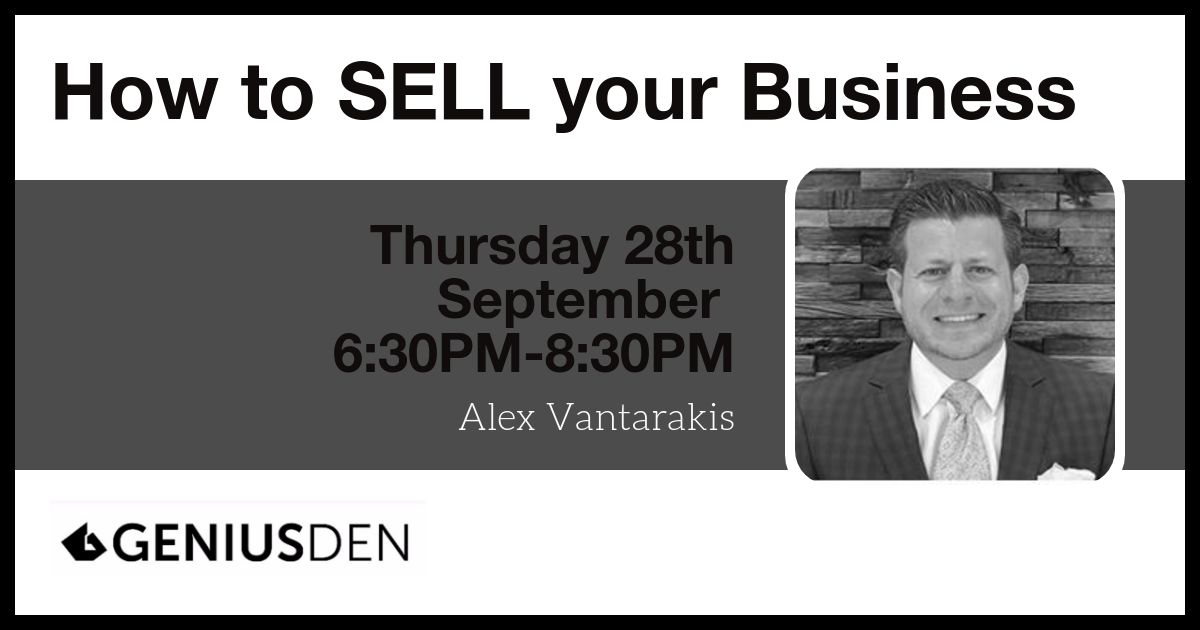
Original event promotion
How to SELL your Business — Alex Vantarakis, September 28, 2017 at GeniusDen.
Original GeniusDen event promotion. Preserved as historical event material.Presentation transcript
Read transcript
A transcript synchronized to the corrected presentation has been conservatively checked against the recording; uncertain wording is left conservative or marked rather than guessed.
Source: GeniusDen archive transcript checked against the recording. Administrative opening and closing material is omitted; the presentation wording is otherwise preserved with light readability edits.
We've got some CPAs here. What we're going to talk about today is a guy who's selling a company, okay? And what we're really going to talk about is what are the steps that are involved in selling a company. And the reason why I like to get an idea of who's going to be at the meeting and what the different types of folks are is everything won't apply for everybody, okay? So what I like to do is I like to adapt my presentations. And the more questions that you're asking, the better the presentation will go and you can make it a lot more interactive, okay?
So, I'm going to go up over here and do this. Thank you. Alright, I do an overview of us, not so much as a commercial, but I want you to understand what an M&A firm or an investment banking firm is. At some point, you're going to have a liquidity event when you sell your business, okay? And you're going to most likely hire an M&A firm or an investment banking firm to go out and essentially shop your business, okay? And our job is to work hand-in-hand with business owners to maximize not only the value of the business, and this is something that I'm going to say throughout this presentation.
How many people, let me do a quick poll. If you could sell your business, would you rather get $10 million or $20 million? How many would rather get 10? How many would rather get 20? Depends on what it is. What do you mean by that, sir? Because, if it's business only, if it's leveraged with stock, is it, is it... What's your name? James. James. James. We can't hear the question. Thank you. I was actually just going to say, I think I was the only one that could hear you, but it's a great question. James said, it depends. And for those of you that know me pretty well, every time somebody asks me a question, I always have one answer, and guess what it is. It depends.
It depends, right? 10 million in cash, or 20 million invested stock options. Or 2 million in cash and an $18 million earnout. Et cetera, et cetera, et cetera. First and foremost, and again, I'm going to jump around based on the audience, the biggest thing that people get in their head is they try to puff their chest out and say they've got a big number for their transaction. And what I'm going to tell you is when you sell a business and you do not receive all cash for your business, you do not have a 100% chance of receiving your funds. You do not have a zero...
You do not have a 0% chance. It's somewhere in between. Okay? All right. So, very quick. We've been around since '99. We do deals pretty much up to $50 million. Southwest. I'm writing two books. If anybody wants a book on either buying a business or selling a business, send me your email. You can get the info from Joe, and I will email you a PDF version of both. Okay? Next slide, please. Next slide. I'm going to skip our commercial. I just want to focus on this.
So, I've been around since 99. I want to focus on the one in the middle, the 80 versus 38. We're 80% successful at our jobs. And for perfectionists, that kills me, right? I don't want to be 80% successful. I'm going to be 100%. But in my industry, for those that have sold a business or have helped people try to sell a business, some businesses are just unsellable. Some situations can't match up with expectations. If you have a business for sale, and one customer is 90% of your business, and you want all cash for your sale, those two things will probably never happen.
So, that's kind of the 20%. So, the reason I'm pointing this out is, in my industry, just like in any industry, there's good, there's bad, and there's different. Okay? And the reason that we're so successful is pretty much because we're a lot more selective. Each of you in your industries knows a good client, and a client that you're going to be able to be successful with. We only work with those. Other firms like to have a lot of volume, so they take on other listings. So, just be careful kind of in the industry.
$600 million in total value. I like $2 billion better. All right. Next slide. No, okay. Alex? Yes, sir. So, you're the founder of the company. Yes, sir. It's nice to know when you started in 1999, but what did you do before that that led you to also then start the company in 1999? That's a great question. I was just talking to Anna. I moved to Dallas. So, you know, I'm probably like most people. I had a lawn mowing route, paper route. Whatever you would pay me, if you would pay me, I would do it.
Okay? So, I've owned small businesses all my life. I went to Boston College and then I went to Babson. I doubt anybody here has heard of Babson, but if you have, it's the number one school in the country for entrepreneurship. So I went there to get my MBA because I want to be an entrepreneur. I don't see how you can teach entrepreneurship because I think it's more inherent, but it's actually an amazing program.
So, when I graduated, well, when I was about to graduate, I went to GE Finance because I wanted to be in finance. And I don't remember the position. I do remember it only paid like, let's say, $70,000 or $75,000, something like that. And they walked me into this big, long row of cubicles. And they walked me halfway down and said, if you got this job, you could sit right here. And I said, that's, I can't work for anybody else. So, I interviewed for an internship in Dallas for a startup.
I was here four months, it was the best four months of my life. I lived with my, my co-workers. All we did was work on a startup. I learned a bunch. There was only one problem. It was a startup oil and gas company taking companies out of bankruptcy. There was only one problem. We didn't have any funding because the owner was full of poop, let's just say. And it was, it was just, it turned out to be a little wacko. So, I was left here not knowing anybody, got a few jobs.
And then, to answer your question, I bought a business. I didn't want to start one because I need cash flow right away. I bought a business. Keep in mind, I'm a young, fresh MBA finance executive. I think I'm the smartest person alive. I bought a maid business and I almost bankrupted. Okay? What was that? A maid business. A house, you can't get any simpler. A house cleaning business. And Big Alex with his MBA and all of his knowledge, I didn't know anything when I went into it. That's a whole other discussion.
That we can get into. People that get into businesses, they don't, they don't understand or don't know what they're doing. When I left corporate America, right, I had a marketing department, a finance department, operations and legal. I had all these departments. Who do you have when you're the owner? Who do you have? Me and Tom. You got it. And that's all that you're going to have. So what happened? I figured out how to increase sales.
And eight months later, I sold it. And I made some money. I thought, well, this is kind of interesting. And the intermediary that helped me buy it made a commission when he helped me buy it. And guess what? When I sold it just eight months later, he made another commission. But I did all the work. Why is he getting all the money? So that's kind of how I got involved, which was candidly the best way. Until you sell a business yourself, until you buy or sell a business yourself, you can't accurately, in my opinion,
in my opinion, in the small, mid-sized arena, you can't really do our job. If you're working on cheap capital on Goldman Sachs, that's a different type of transaction, okay? Down here, it's more of an emotional transaction, okay? Under $50 million is a small business, okay? There's all different variations of what's considered small. But under $50 million in revenue is kind of all clumped in with usually an owner-operator that hopefully has a good management team, but he's still kind of the puppet master. Once you get over $50 million, then you get into a larger organization. Great question.
Great question, Mike. Thank you. Yes, sir? One of the true things about having a business that's sellable is a business that you, as a person, run, but if you walk away, the business still will make the same money. Hold on. I'm going to ask if we could get through this slide deck. And the good thing, here's the good thing. That's an awesome question. But in this format, you're going to give us a lot. Let's take what you have to offer. I will. And that's kind of answered.
Then we're going to ask Q&A for like 10, 15 minutes. And then we're going to kind of run it out of time to get face to face. Is that okay? Cool. Let's do that. But hold that question. As soon as I go through my commercials, I can move away. Skip this one. Great. Oh, what kind of services do M&A firms provide? Here's something cool. Let's say you own a business. Somebody said a home, elderly care. And you want to expand. There's two ways you can expand, right? You can get some help.
You can get some else people. Well, this doesn't really apply to me. You can get some else people and go open up new territories. Or you just buy your competitors. Okay? That's another service that we offer. We do valuations. Advisory work is similar to coaching, but not really. We usually get a coach to come in after we set up their advisory. And then debt fund. Okay? Next slide. Let's skip all these. Because we're having some good questions in the audience. Good questions in the audience. Oh, yeah. Can we get the slide deck from you?
Is that okay? Oh, yeah. You'll get the slide deck as well. So email Joe. We're not skipping anything important. This is my commercial. All right. All right. There's the two books that you're going to get. One more. All right. The selling process of a business starts with packaging a deal the right way. Okay? I'm going to say it again. Understanding what is for sale sometimes gets missed at the beginning of an engagement. I'll give you an example. Think of this dynamic. Justin, you're busy all day, right?
Right? You want to sell your business. And you're talking with me. And my job is to sell your business for you. So I have questionnaires for Justin to fill in. And I have conversations with him. But if Justin's never sold a business before, he doesn't know to give me the answers to questions that I'm not asking him that are specific to his industry. Okay? I'll give you a perfect example. And this is all leading to this preparation call. We have, we had an HVAC rep business for sale. Those big HVAC units.
On big commercials. These were engineers that were designing these units. Okay? And then they had sales people as well. And the owner was the main sales person. And the owner made 700 grand a year. And when you figure out, and I'm going to fast forward, the way their business's price is off of EBITDA, or cash flow, or adjusted EBITDA, or adjusted cash flow. All these terms mean the same thing. Okay? In a small business, you add the owner's salary for EBITDA. And you come up with this big number.
Well, what he forgot to tell me, and you tell me if you think this will have an effect on how much cash flow there is to a new buyer, is that he wasn't taking any commissions for the work that he was doing. So, if Justin bought the business, he would have less cash flow, right? Because somebody would have to be paid those commissions. The owner was selling as well as running the business. We neglected to tell him that. So fast forward from preparation all the way down here to negotiation, which is six months later, and I'm saying
six months later, and I'm sitting across the table from a buyer, after he's done his due diligence, and the buyer is telling me, your cash flow is wrong. And, of course, I'm saying, well, it's not. Well, tell me. And he's saying, yes, it is. And he's explaining why. Preparing a business and understanding all the components of the business that are for sale. Understanding that one customer is 90% of the business. How many people think that one customer of 90% is a good thing when you're running the business? Don't be afraid. Don't be afraid. When you're running--
The business, you can handle it. It's never a good thing. You can handle it. How many people think it's a bad thing when you're selling? It's a bad thing when you're selling. So, whether you have a 90% customer and whether it's a good or bad thing depends on a lot of different factors. If the 90% is your dad, it's a lot more secure. If the 90% has a 30-year contract, it's a lot more secure. But most of the time, most sellers are going to say, hey, this is great. I only have to deal with one customer.
Look how easy my life is until you lose that customer. Okay? So, preparing a business for sale usually takes about a month because for an advisor to do his job properly, he's got to understand all the questions and anticipate questions that a buyer is going to ask. The more prepared we look, the better off our clients. Keep in mind, a buyer does not talk to a seller until probably he's reviewed financials, talked to us, and it's a long process.
Marketing. Marketing a business in a small, mid-sized business has become very easy because of some listing websites that are out there. Everybody know what MLS is? That's a real estate listing website. There's nothing really like it for businesses, but there's about five or six different websites where if you amalgamate them all together, you can pretty much find all the deals that are under $50 million. So, that's one way you market a business. How else do you think, if I had a business for sale, let's say it was a $20 million a year landscaping service.
landscaping service company. How do you think a firm would market a business for sale? Knowing that, we can't say, oh, Joe's landscape business is for sale, you know, put an ad in the newspaper or on TV, et cetera. Yes, sir? Probably network through like LinkedIn and do networking, you know, affiliation, you know, having a chain of things. Excellent. Networking through affiliations and chains of networks. So, the bigger a network is for an advisor, the better off the market. What do you think is another way? Who do you think would be interested in a landscape company?
Other landscapers. Other landscapers. Anna and your name? Jen. Jen. Anna and Jen have the same answer at the same time. You're both exactly correct. Other competitors. Today, right now, there's more M&A activity on the buy side than I've ever seen in my career. Anybody that owns a business right now should get as big as they possibly can. Why? What's coming in the next two to five years? The shift of interest rates so people can respond. Jen, you're getting way too advanced. That question is correct, but that's like level 507.
James is saying interest rates are going to go up, which is an excellent point. Now, think about buying a house, okay? If there's a $300,000 house you want to buy, and interest rates are 2%, and all of a sudden they're 8%, that house just became more expensive in your eyes, because the debt funding is more expensive. Same with the business. That's not what I was going to say. That's an excellent answer. What was my question? Why shouldn't you get as big as... Why shouldn't you get...
What's going to happen in the next two to five years? Come on, we can be negative in this room. My recession? Yeah, something's going to happen. We're in Dallas, Fort Worth. First of all, there's no recessions ever here, right? I don't think there is compared to the rest of the country, but a recession is going to hit, or a slowdown, or any impact where every business isn't growing 20% year over year, like what is going on right now. So, what we're telling all of our clients, and even how do we ever get paid
because you're going to get a reduction in your sales, and you're going to come back to a level that's hopefully higher than where you were. So, that's why acquisition searches right now are so big. Okay. So, that's how we market. Due diligence. Due diligence is the least favorable part of my job. Right? Because my job is to work with a buyer to justify all of the reasons why we believe the value of the business is the value of the business. Okay? That's a very broad statement.
That's a great question. Who do you represent, the buyer or the seller? That's an excellent question. We represent sellers and buyers. We prefer to represent sellers. Can anybody guess why we prefer to represent sellers? Yes, sir, in the back. We're more likely to close, and you've got your commission. Why are they more likely to close? Because they're interested in selling. Yes, you have the next time. It sounds like a simple comment, but he's exactly right. A seller, excuse me, when they decide to sell, is going to sell. They're done.
They're done. Something has happened. Either retirement, health, moving, family, etc. There is a definitive ending for a seller. Let's take a buyer. Does a buyer have to buy a business? They want to. They would like to, but they don't have to. That's one reason. The second reason is selling a business is infinitely easier than helping somebody find a business for sale. I'm going to tell you why. I'll use the pretty girl at the dance analogy. A business for sale is a pretty girl at the dance.
And all the [unclear] are buyers. There are plentiful buyers. There are not enough sellers. And plus, the sell-side fees are much, much spicier. So to answer your question, we represent both. The way that I'm speaking on this presentation, we're representing the sellers. Excellent question. Due diligence is the least favorable job. We talked about that. Because it's just, you know, a good buyer, here's the good news. There are certain things in due diligence that you should attack, and there are certain things that you should not.
And there are certain things that you're just attempting to attack. And part of our job, believe it or not, hopefully we get multiple people interested in our offerings. Okay? And if that's the case, our job is not to pick who will pay the most. I've already given you one example about the 10 versus 20. That's just one aspect of sale price. Okay? The other aspects are infinite. How hard is due diligence going to be? How long are they going to want you to stay around? There's so many components tied to doing a deal that have nothing to do with the sale price, and we're going to focus on most of those.
And I'm going to focus on most of those today. And last but not least is negotiation. That's the fun part. The diligence is done. We agree to agree. And then we negotiate to get the closing. To sell a business takes roughly three to nine months. Roughly. Next slide, please. I'm talking about this. Next slide, please. That's our theme of your community. All right. So, there's two ways we can do this presentation. One is, there are lists of topics that are two pages long that we can discuss and have an open forum.
The other is a layout of the entire sale process. In my opinion, based on the people that are in the room, I would suggest that we go with the topics. But I'm happy to do it however you guys want to do it. So, if I have a consensus or one hand asking for one or the other, I'm going to go in that direction. All of those topics. Topics. I'll do it by your head. Okay. Let me do this. Let me go through the steps. I'm going to go through all the steps in about ten minutes.
And then we'll go to the topics. And then what we can do is we can have a topic around some of the steps. And then we're going to get to your question. Business owner decides to sell. Well, that's silly, right? Of course he decides to sell. So, why do you all think that's a step? That's the first thing you have to do to even start the process. And there's an emotional attachment sometimes, right? I mean, you're weighing, almost getting rid of a child, right? If you've grown and cultivated otherwise.
So, there is an emotional attachment to it. You're putting a lot of energy into the client. You want to commit to half. That's the real reason. Let's take a step back. Let's look at Alex Vantarakis, the M&A intermediary. What do I sell? My knowledge and my time. Why are we 80% successful? Because I only want to work with people that I know want to sell. So, what are some, I'm going to give you some scenarios of people that we politely don't work with. There's nothing wrong with their businesses.
They're just not ready to sell. They just don't know it yet. Two partners run a business. They each make half a million dollars a piece. Okay? And those physicians need $150,000 a piece to run. And they make, let's say, another $300,000 of profits. Let's just say they make $800,000 combined. The business is worth $24 million bucks, somewhere around there. I'm using ballpark figures to illustrate an example. And let's say they're a C Corp. And I'm not going to bore everybody, but on a C Corp, they'd be double taxed. So let's say they're going to get $4 million.
So, let's say they were going to get $4 million. They're left with two. And they've got to make commissions and fees. And they get a million eight at closing. They both make a half a million dollars a year. What do you think is the next conversation I'm going to have with them? Why should I sell? I could just work in the business and make this amount of money. They're not ready to sell. Okay? There's little signs like that about a business owner really being ready to sell. Because the problem is
And I've seen it with my own eyes, when an owner is dipping their toe in, and you're going through a negotiation that's very difficult, what do you think is going to happen? If they're not committed, they're just going to be like, you know what? This isn't, I'm not interested. So, unfortunately, I have to have very difficult conversations with business owners to tell them, look, it's not just for me. You're going to take a lot of time. You're going to take a lot of resources. You're going to get mentally
Invested in this process. And if you're not ready to sell, the worst thing that you can do is get to the table and not close and then have to move. Okay? So, step number one is how to sell. Determine the value of your business. We're going to get into how to determine value, because I'm sure that's a topic that a lot of you want to talk about. When you add your information into a marketing package, a marketing package or a CIM package.
or whatever verbiage we want to use is an instrument put together to market a business for sale. Okay? And there's going to be probably five to ten basic pieces of information that should be in any marketing package. Not the CPAs, but can anybody else tell me what they think would be in a marketing package? Competitive landscape. Competitive landscape. Competitive landscape. That's definitely one. That's not a primary, but that's... So, what you have is you're going to have five primaries, and then every package is going to be as big or small and as needed.
and absolutely the competitive environment is one. But what's one of the must-haves? Three years of history and two to three years of projection. So, three years of history. Now, let's talk about projections, because that's kind of interesting. How many people believe projections of business owners? Let me say it differently. How many projections of business owners have ever been overestimated? A hundred percent. A hundred percent. Ding, ding, ding. That's the right answer. Depending on size and scope of a deal, projections are either useless or imperative. I'll give you an example.
We have a sports memorabilia, a sports memorabilia business where they don't sell memorabilia out of a... They have a retail store, but that's not the business. The business is going to stadiums and being the exclusive provider of signed merchandise at all these different arenas and signing up more schools. Every school constitutes income, right? It's a great business. Makes a million dollars a year in profit. Three, four million in revenue. Something like that. And in this business, he started at a very small EBITDA. And last year, he had a big EBITDA.
And this year, he's saying he's going to have a crazy EBITDA. You like my math? So, of course, how does he want us to price the business off of the crazy EBITDA? So, projections for him are imperative, but luckily for me, my projections are not based on this is what we think will happen because this is what we think. He's actually signed up teams where the revenue won't kick in until the contract starts. That's a different type of projections than your standard, hey, I think we're going to grow 20% next year, et cetera, okay? But to your point, yes.
Projections can be valuable, but more importantly, right now, tax returns and financial statements. So, don't projections set the tone for negotiations? You're basically putting a frame around what you want them to start thinking about? You're exactly correct, and projections usually come into place around one type of financing, and that's going to be an earnout. An earnout. Most businesses will sell for cash and owner financing, under $50 million. Stock exchange and all this stuff, that doesn't apply in under $50 million. It's possible, but I'm going to put that to the side. So there's three ways.
Three primary ways you pay for a business. Cash, owner financing. Owner financing means I'll sell my business to James. I want a million dollars. James is going to give me half a million. I'm going to have a note that James owes me a half a million dollars, okay? And the third is what's called an earn out or contingency. Hate earn outs. You know why? Because that means a business is either doing really, really, really well or is really, really, really poorly. If you have a, I'm going to use a landscape business because that's easy conceptually.
If you have a landscape business that does $3 million in revenue in 2014, $3.2, $3.6, and $4 million, okay? Well, you pretty much know what you have, right? You've got a business that's kind of growing 10% to 15%, and you're going to price it, and you're going to use the latest year's EBITDA because you believe the trend is real because you've seen it, okay? Unlike a business that has $200,000, $200,000, and then halfway through the year, they have $400,000 in profit, okay? And at this point in time, a buyer comes along. How much fun is that?
How much fun do you think this exercise would be, right? It's not going to be fun at all. I hate this. The seller is going to say, well, whoa, I'm about to take off. It's too low. You know, I want all the value that I've built in, and a buyer is going to say, I don't know what's going to happen. How do I know this isn't a one-off? And by the way, what's the other thing? There's three people involved in the transaction. Seller, buyer, who can guess the third?
Financial. Who? Except for me. What did you say? Financial. A bank. Somewhere there's money. The source of funds, okay? So I'm a buyer. I want to buy this business, the skyrocket. I'm going to go to the bank and say, I want a $2 million loan. No problem. I need three years of tax returns on the business. No problem. Here they are. Well, two and three years ago, they can't cover the debt flow on this. Well, I know that the business is going to go up. Yeah, but the banks get a little squeamish with that, which is why projections in that case can actually convince.
can actually convince a bank to provide funding. So an earn out is usually used for that huge spike where a buyer will say, look, I know that you've done $200. I'll pay you all cash on what the business is worth at this time. And if it continues, I will pay you an additional amount of money. Here's a question for you guys. You have a buyer and a seller. And each one of them wants to tie some number, right, to an earn out. And you have sales, gross profit, and profit.
So sales minus cost of goods is gross profit, and then profit. Which one do you think the buyer wants to tie it to? Net income, net income, profit. Which one do you think the seller wants to tie it to? Sales, yes. So sales, yes. All smart. Somebody tell me why sales and why profit. Yes, Keith. But buyers, they want to make sure they only pay for a percentage that actually gets to their bottom dollar. For the seller, if your buyer comes in and screws everything up, you want to tie it to sales.
So you want to tie it to an independent matrix that you know can keep going, even if they mess up the operations. Seller has no control over expenditures, only sales. Buyer has control over expenditures and can depress the bottom line. So which do you all think is the one that gets settled on the most? Gross profit. Everybody hear that? Gross profit. Okay, why? Well, if you know what your gross profit is and you know what your overhead is, as a seller, sorry, as a buyer, you're going to be a little bit more comfortable because you can control.
You can control that overhead. And as a seller, although it's not off of revenue, you know what your historical cost of goods would be. So you kind of usually settle it. Then you just have to negotiate what's included in your cost of sales. Correct. And usually, everybody hear that? You have to negotiate what's included in your cost of sales. So if it's on gross profit and I'm the buyer, I'm going to say, well, look, I've got this override to this cost of goods allocation of all of my overhead and get into this very heated discussion.
heated discussion. Great point. So gathering information, marketing the business we talked about, identifying potential buyers, arranging meetings with buyers and sellers. I got a newsletter that I sent out and I wish you guys had received the last couple of columns because I put, I decided to stop being so serious. So I put something called Vant Rant and Murphy's Law. Okay. And Murphy's Law is all the crap that I've seen that has either kept the deal from going or closed and I couldn't believe it and Vant Rant was just me pitching about buyers and sellers.
stuff. Okay. So arranging meetings with buyers and sellers is a key pivotal part in your transaction. Okay. When you deal with under 50 million, I said something at the beginning, what applies more in a small transaction than a big transaction? Emotions. Okay. This is most likely a 55-year-old man or woman who has owned a business for a long period of time that is looking for an exit strategy. Most of the time, this is their asset. Okay. Just let that sink in. It's like saying, I'm going to negotiate your retirement account to buy it.
All the money that you have is in your retirement. So if I could, if I could trade in my MBA in finance, I swear, I really wish I could do this. I would go back and get a psychology. Because my job is not finance. That's easy. Look, let me be clear. All the financial calculations, anybody in my position should be able to do. It's basic 101 now. Being able to handle tiny issues that turn into huge. It's like a dam that's got a little tiny hole in it, right? If you don't put your finger in it,
And if you don't put your finger on that hole right away, the whole dam is going to explode. I'm trying to think of one of my Murphy's laws. If I tell you anything could go wrong, okay. I had a closing and the sellers was a couple, sweetest people in the world, up in Sherman, Texas. They owned a little decorating design business. They're so nice and helpful and the cutest thing you've ever seen. The buyer was this horse-throated, cigarette-smoking East Texan.
And every time we got together, a party started. Because she would get a little rough and they would get offended. So I had to keep them away as much as I could. So we get to the closing table. This was actually just up on that last week. But we're at closing. And it's me, this lady, and my partner, and the sellers on the other side. Bless you. And I think they were arguing over like a $100 security deposit on a storage facility. It was like a million dollar transaction. We're at closing.
We're at closing. It's $100. Let me say it again. We're at closing. It's $100 security. And, of course, they're trying to be as nice as possible. And I'm just ready to say, I'll just pay it. Don't pay it. That's coming. I can't make this up. This lady reaches down into her purse. And she reaches up. She gets to about this high. And she's got to buy this thing. And my partner, my partner takes her hand and pushes it down. Glenda, why don't we go outside and come back?
And she went off. Oh, son of a beast. You know, this hundred dollars, this is principal of what? And she went off. And we, I'm still alive, so nothing happened. But that's an extreme example. But if I tell you I can give you another 20 examples like that, I probably can. So emotional. Meetings with buyers and sellers. Understand that when you're either buying or selling, it's just like anything in life. You have to put yourself in the other person's shoes. My sellers go on and on and on about how wonderful their businesses are. And I tell them,
From the first day they sign up, let me be really clear. I'm going to talk to you every day like a buyer. I'm not your agent. I'm a buyer. And I'm going to be telling you stuff every day that you're going to be hearing from buyers so that we can start prepping. How well do you think those conversations go? But, by the time I get to a buyer, he's already gotten really upset at me so that when he's talking to a buyer, he understands what's coming.
And then when it comes, when a buyer says, your age force is averaging 63 years old and I have to budget for acquisition costs of getting new talent in here and training and I'm going to discount the business. And you hear that for the first time and you're proud of your 63-year-old staff. How do you think that's going to go? So these are kind of the discussions to think about whenever you get into one of these scenarios. Offer to purchase, letter number 10, best time, right? This is when you actually get an offer on your business.
on your business. Negotiating deal structure, due diligence and closing. Any questions on the steps, understanding that there's topics on the previous phase. Are there anything specific on the step? So we went through two of the three, I think. What was the third of the pillars that need to go in that package? Three years of history. Great question. Two years of history. So you need an executive, you need a subliminal, meaning what is the deal? So if you say, well, this business is marketed for sale for $5 million, well, great, what does that mean? Do I get the balance sheet?
With me? If I do, how much of the balance sheet comes? Does everybody understand what I mean by that? Let me take a step back. You have two different types of sales most of the time. You've got an asset sale and you have a stock sale. On a stock sale, it's like going to Wall Street and buying all the shares of a company. That's basically what you're doing. And you take on all of the liability as well. How many stock sales do you think buyers prefer?
A stock sale or an asset sale? An asset sale. An asset sale. When I want to buy something, I want to know that what I'm buying is free and clear of anything I do not know about. See, buying a business and having hickeys on it or having issues is not a problem. Buying a business and not knowing it is the problem. So, stock versus asset. If you buy a stock sale, you buy everything just the way that it is. Which means the day of closing, you get the keys, the bank accounts, all the debt, all the unforeseen issues.
The unforeseen liabilities, all the payroll, tax, sales, tax, et cetera. Okay? An asset sale is normally balance sheet free. What I mean by that is normally I say, James, I'm going to buy your company. Here's a million dollars. You go pay off all your debt, you pay off all your suppliers, and as the accounts receivable, I mean that you collect them all. Most deals fall kind of in a hybrid. Okay? When you buy a business, you probably need some working capital. Okay? So, if you buy a business that does not include cash or accounts receivable, that means that you either have to take money out of your funds and place it in an account or go to a bank and get a line of credit.
bank and get in line with credit to put it in your business. So, although most of the time the balance sheet is never included, in theory, probably 20-30% of the time accounts receivable are negotiated into the sales price. So, back to, so you need tax returns, financial statements, you need an executive summary that basically outlines everything that's in there. And then you want to have, I think this is important, pretty much a Q&A of the 50 questions that are always asked. So, we've put together kind of a template of that.
And then employee information, not names, not social security numbers, but a basic org chart. Because if I was to ask you, what's more important when you're buying a business? Employees, customers, or sales? What do you think it would be? This is a trick question. It's all. But very few times people say employees. Employees, and let me be clear, depending on the type of business, are extremely important. Okay? If you have a fast food operation, the key people are your managers, and you want to keep all the hourly workers, but that's a lot of rotation.
As opposed to, let's say you have a manufacturing rep business that does $100 million a year, and you've got 20 salespeople that have been there for 20 years, and they have relationships with all... How much of the value of the business do you think the buyers place in the employees? Tremendous value. Okay? Let's take... Let's go on a tangent for a second. How many people do you think, with these important employees, have non-compete and non-solicitation? If you were to guess... How many? Ten. Ten. Nine. Five percent.
I'll tell you another story. I just sold a sign company, a good size. One sign company that was about $5 million in revenue bought another sign company that was $5 million in revenue. I represented the seller of the company. But the buyer and I became very good friends. And three days before closing, or four days before closing, four days before closing, four days before closing, the buyer texted me and was distraught and said that his manager didn't want to work at the company that was being bought for whatever reason.
And he went off and got a job. And it's his GM. Okay? So that's an issue in itself. But we're all big boys and girls. We can live with body blows that the business gives us. And like most employees and like most good owners, he developed a relationship with this guy. They've been friends and buddies. So he takes them out to lunch. And he says, well, sorry that you have to go. I don't want you to go. Thank you for all your service. I said, you know, I'm buying this company and you're leaving.
So, and like most employees and like most good owners, he developed a relationship with this guy. They've been friends, buddies; he takes us all to lunch, and he says, "Well, sorry that you have to go. I don't want you to go. Thank you for all the service." I said, "I'm kind of discovering you're leaving, and we don't have a non-compete or non-solicitation. Would you sign one?" What was the answer and why? No. Excellent. And why? One is, I don't need you, and candidly, that's the biggest one. So one of two things. First of all, let me tell you what happened. I do not believe, I hope not, that this manager is
Actually going to steal his customers. I believe that the story that he told him is true, and I'm sticking by it, which is, when he signed the contract, he did not have a non-solicitation or non-compete. So he signed the document saying, I do not have a non-solicitation. So he can't sign. Okay? So that's a one-off example. Let's talk about what would normally happen. What do you think would happen if I went to James and said, James, I need you to sign this non-solicitation. Everybody knows what a non-compete is. You're a, you're
You're a, you're an attorney. By the way, there's very few fields that you can actually uphold it on. The non compete basically says, you can't go compete against the business, which is almost like a sales, a sales package. Yeah. But there's a big difference between a non solicitation, which I'm telling you all right now, if you have businesses and you do not have a non solicitation, you need to go home tonight and call your attorney to get one. A non solicitation is the easiest document to get an employee to sign because it's not saying, don't go out
It's saying, don't go out and earn a living doing what you're doing. It's saying, if you leave, don't take any of my customers. And all of my customers are off limits to you. You understand? It's a subtle but huge difference. Normally what happens when you go to an employee after the fact to try to get a non-compete is one of two things. Either you're writing that employee a check, unfortunately, or you're not getting the non-compete signed. I promise you there's almost no other scenario. Do it up front. All right. So these are the major steps involved in the process. Yes, sir?
Mike. Now if you presented the scenario as if there was one buyer and one seller, but there's also scenarios where there are potentially multiple buyers and therefore the dynamics are different as to how I would imagine you play it out to maximize the value representing the seller. Could you elaborate on that? I sure could. I thought earlier I said that the due diligence or whatever it was was my worst, my worst point. That's not the worst. The worst thing that could happen in any transaction is actually what Mike just described. Believe it or not, let me say it.
Again. What Mike said was we have a client for sale and we have multiple offers. I was like, can you treat it like real estate? Because to me, that's what I imagine would be the perfect way to do it. When you have multiple offers in real estate, they say, okay, take your best final offer and then everyone scrambles around because they think they're going to lose that business or lose that sale. So their offer goes from whatever it is to maybe another $200,000 or $300,000, whatever.
The answer in a roundabout way is going to be yes, that it's called an auction process. But let me tell you the difference between selling this building right here, okay, and a business. If you sell this business, this building right here, it's $220 a square foot. There's a calculated amount of square feet and there's a sale price, and there might be an as-is clause, or maybe one or two minor things that can make a difference above and beyond the sale price. So if Joe gets three $2 million offers, they all look the same because there's nothing else to come along, right?
It's not the same when you sell your business. So when I say that I don't like it, it's not because I don't want to do the work. It's not because I don't want my client to get the most amount of money. It's because that process and educating my seller, you guys have to understand, zero to 50 million in revenue, okay, are very smart business owners, okay. Most of them have never sold a business before, okay, and most of them don't really understand the process, as much as we try to educate at the end of the day.
Most business owners are scared. What happens when you're scared? You freeze out. You don't know what to do. You overreact. So understand that that's all going on. So now I'm presenting my business owners with four offers, okay. They're all at different variations of sale price. That's the easy part. Now they're all at different variations of earn out and all different variations of how long it's going to stay and one's going to offer insurance for a while and lining that up and setting up expectations and making sure that myself...
My seller is communicating with me as to what's most important to him. That process is difficult. Now, how would we do it and what do we do? We work backwards. We meet with our sellers and we start asking the questions of what's really important to you. And this is how we phrase it. If we got you two million dollars, but that was a year from now, is that a better deal or a million today? How comfortable are you with leveraging? And when we get the answers to those questions, we look at our buyers.
And we figure out which is the best one to work with. So let's just say a seller has a health issue. Obviously for him, timing is going to be of an issue. So let's say I have two competing offers. One of them was going to go and get traditional bank financing. That's a 90-day process, okay. One of them is a professional search fund that already has some money in the bank and the decision maker is the actual person looking at the business. But he's offering five percent less, whatever.
two percent, whatever. I'm going to tell my client to work with this employee because I know what this process is like. So going back to answer your question, it's a cool predicament. It's the way we handle it is by understanding what's most important to our client. That's the simplest answer. Great question. Thank you. Anybody else in the process? Yes, ma'am. I have a fundamental question on number one. When is, when do you, as a small business owner, what is the right time to say to start thinking about selling? Excellent. Excellent.
Yeah. When is the right time to start thinking about selling? It's a very easy answer. Anybody? When you start your business. You all say the same thing. Day one. Day one. Get your QuickBooks, Keith, right? Get your QuickBooks running the right way. Get with a CPA to set up your books and records as to how you want them to look when you sell. Get all your marketing stuff set up. Selling to businesses, you know, little things like this right here, you know. Believe it or not, there are some businesses that don't have simple marketing.
Material on their business. Is that a big deal? No. But let me tell you when it becomes a big deal. I'm analyzing James' business to buy. Sales have been flat for a while. Well, how could sales be flat in 2017? It's probably not advertising enough. Its product is bad. Its pricing. There's something wrong with it. The buyer determines his website's 30 years old. They didn't have any printed material, etc., etc., etc. All of a sudden, now I have a budget that I have to pay.
All of a sudden, what does that budget come off with? A sales price. So little things like having marketing materials set up, operations manuals, training manuals. The best book to read, and it has nothing to do with selling a business, is E-Myth. Everybody read E-Myth? E-Myth, Gerber. Why is that the best book to read when you're thinking about selling a business? Not you guys that know this stuff. No cheaters over there. No cheaters over there. I need this side of the room. You guys are too smart for these great things. Anybody? All right, I'll go with Keith. Keith?
Because whenever a buyer takes over, they want to know all the processes associated with your business. So you set those all up ahead of time so it's not a waste of your life. Keith is saying, the E-Myth is written to basically say, set up your business like it's a franchise. What do you buy when you buy a franchise? A system. If you set up your business like a franchise, with a system, when you go to sell and you hand over, here's my operations manual, my HR manual, here's the last 10 raises.
That we've given, here's a vehicle report. If you have all of that, and again, I hate to make examples with a car and a house, but a car kind of comes to mind. Let's say you've got two used cars. One of them has a record of all the repairs that were done, showing where it's going, showing everything, and then you have another one that doesn't have anything, and they're the same price. Which one are you going to buy? Okay? Even if they're not the same price, there's a value that's built in.
that's built in on this one. Same thing with the business. Great questions. Did that answer your question? Anything else on process? This is to go back to us. Yes, let's go back together. And now I'm going to get back to James's question, if you can still remember it. Which one? I don't know. It's a good one. I don't want to put you on the spot. You think about it. I'll have to rewind the tape. All right. There was something I read to that question she asked. When you're starting a business, your ultimate customer.
your ultimate customer is not who you're selling the product or service to, it's who you're selling the business to. So with all your experience, how would you frame that for an entrepreneur who's starting a business? What process would you go through? Because you're saying you've got somebody that's got 55 years in the business, and they're like a deer in headlights. So we have the benefit of time out in front of us. What would you do from day one to not? To not be set up that way? I'd go back to
email. I mean, I don't want to answer that. Yeah. I think I might not be understanding the question, and I apologize, but I think it's similar to what. So I'm in technical software with a construction background. I know who my customer would be, but my ultimate customer may be one of my competitors. So as I'm building the business, how would I frame it around selling it to, like, a company, Microsoft? I gotcha. I gotcha. Okay. Great question. Thank you for clarifying. So there's best practices in every business. I'll give you a good example. I bought a catering company.
okay? And there's $2 million in revenue, and a good food business should have less than 30% food cost of goods, less than 30% labor. And this business grew 25% when we bought it, the year before we bought it. And this year, my business, the last 12 months, the exact number is 30%, 33% probably. And what I'm doing is I'm figuring out what is the best catering business look like? And I reverse engineer. And I think about, this is the way you need to think about it. If somebody
came to you and said, buy my business, what would you want it to look like? I'll give you a very specific example. I also own an MSP, managed service provider, who fixes computers and servers, okay? I know my business inside and out. I know that a buyer is looking for managed recurring revenue. Actually, we're going to touch on that right now. Actually, I'm going to take a break to talk about it. Everybody know what recurring revenue is? Recurring revenue is the most valuable asset you will ever sell in your life.
There is nothing more valuable than recurring revenue. There's nothing more valuable than buying a mortgage note on a house, but you know you're going to get recurring revenue. There's nothing more valuable when we sign up a client. We get a three-year contract. We know how to budget our employees. We know how to budget our cash, okay? When you don't have recurring revenue, what are you doing? Every day you're getting up, you're getting your life, you're out there, and you're killing stuff. You got, like they say, you're up one month, you're down one month. It's a horrible way to live.
But some businesses are just designed that way, a coffee shop, okay? Yeah, you have an idea of what your revenue is, but it's people that are going to come in or people that don't. So managed recurring revenue is what everybody looks for. So going back to businesses that could have the same, that look exactly the same. Remember we talked about pricing businesses and valuations? If you have a business that makes a million in profit, one's managed recurring revenue, and you have a business that makes a million dollars of non-managed recurring revenue, you'll probably get at least a one-time difference on multiple.
difference on multiple. One times a million is a million, okay? That's a lot of money. If you have managed recurring revenue, you more likely than not have more systems in place. Why do you all think that is? If you have managed recurring revenues, you have more predictability as to what's going to happen. I would rather sit back and make a plan, right? Knowing, not hoping, but knowing that I got all this revenue coming in next year. I know the exact amount of people to hire. As opposed to if you're a wholesaler, you're just
A wholesaler and you're just selling stuff, you don't know, you don't know how much inventory to buy, okay? So managed recurring revenue is key. Yes, sir. The question I was asking before is, is the best selling business a business that the business owner can walk away from? So James's question is, isn't the best business a business that you should be able to walk away from? And still run and still run? I'm going to answer that question a bunch of different ways. I'm first going to say e-myth, e-myth, e-myth.
Yeah, because if you follow e-myth, you have that business. One of the first three questions we ask our sellers when they sit down with us after 'what is your name' is, when was the last time you took a vacation? No joke, I have it in all my procedure manuals. Why? What are the answers you think I get? Never. Never. Never. Oh, I take a vacation all the time. I take my laptop and I go away for a day and
you know, I come back. If you have a business that runs itself, and this is why valuations are so different, right? And we do, look, let me be clear, we do paid, board-certified valuations and I can tell you that our valuations could easily be off 50% one way or another. And I can tell you that everybody's valuations could be off 50% or 100% or 200%, or a value of 10, I've seen a value of 10 million be worth zero because the evaluator didn't ask the right questions. If you don't ask or go back to remember we were
doing due diligence and I said we spent a month doing this and you miss a, you miss the commission question here or there, you miss, uh, here's a question. Uh, need somebody. Lee, do you have contracts with your clients? Yes. Let's say you do. Yes. Yes. And that's great. You have contracts, I'm checking the box out. What's the second question I should ask, right behind, do you have contracts? How long, how much money do you have, what's the payment cycle, termination fee? How long, termination fee? What else?
What else? What else? Are they cancelable? Are they 30-day contracts? Yeah. You talk to a janitorial cleaning company that has 30 million dollars in contracts. I've got a buddy who's got 30 million dollars in contracts. I know them. And this is great. To live in the life is like, do every month's things. You need every month's things. All my contracts in the industry are 30-day cancelable. So if that company does a million in profit or James' wholesale manufacturing company with three-year contracts does a million in profit, which one's worth more? I don't have to tell you anything more. You know which one is worth more.
which one is worth it. And that's why going back to valuations, valuations are, what were you talking about? Oh yeah. I can't believe I'm going to admit this. I brought to show you that a business is worth what a buyer is willing to pay for it. I'm going to give you a real life example. I have a very small cup holder. What the hell does a cup holder have to do with them? I'm getting ready. A very small cup holder. It's a very small mug that can fit into my car cup holder. And it's a Starbucks mug.
black one with the cool swirls. And I bought one. I left it in front of Texas Security Bank. And I love this mug. And I am very frugal. Anything that's under $200, I'll try to save, you know, a penny. But all the big-ticket items I'm okay with. Because my rationale is, if I save all my money down here, I can go and spend more on these. So, I told my assistant, I want the Starbucks mug. I'm like, go find it for me. So, she looks and she looks.
looks and she goes, and it's worth it for like a week. Because they don't make them anymore. She found one. And I bought it because I needed that Starbucks mug. You guys know what I'm talking about. Those $29 or $39. How much do you think I paid for that mug? Take a guess. $400. How much? $97. $92. $97.92 for a coffee mug. Because I really needed it. And I really wanted it. It's a long analogy to get back to. And this is, I want you guys walking away from this. You could all hire me to do a valuation.
evaluation. And then you could go talk to five of the best advisors that you have. And they're all going to tell you that my valuation is wrong. And none of their five numbers are going to match either. And you probably saw this when you were selling your business. And Keith, you've seen this a million times. A business is worth what a buyer will pay. Now, are there underlying principles? Of course there are. Okay? What is the primary driver to value? Profit. Profit. Cash flow. Primary driver value.
Profit. Cash flow. I bought a company for my IT managed service business. It had a million in revenue. Zero profit. Why would I do that? It was in Austin, by the way. Why do you think I would pay a couple of hundred thousand dollars for a business that has no profit? Maybe because of talent and clients? Profit. Talent and clients. What I didn't tell you was my partner and I wanted to open up an office in Austin. So we found an office that had a million in revenue and no profit. Well, first of all, the day
we bought it, do you think it had no profit? No. Because we got some resources. We did what people do when you normally buy it. And that was nice. That's a little bit of cash flow. But what did we have all of a sudden? We had established employees. We had IT managers who were, so you've got, if I was to rank the things of value that affect value, I'd say it's your net income, it's your revenue, it's your growth, and probably next or the one after is your employees. Okay?
And for us to hire six IT folks in Austin, do you know how much that would have cost me? A million bucks. Sorry. Just for the recruiter, sorry, the recruiter fees. A hundred thousand dollars. Just to hire the six people that I already had. I already had an office, I already had computers, I already had a system, and guess what? I didn't have all the money. So to me that was worth $136,000. That's how you paid them. Yeah. We paid them $3,000 a month for four years. Okay? Going back to value. Value is not the same. There are
There are circumstances where the value for one person is not worth it to the other. But underline, I'm going to give you rules of thumb now. That is a very broad rule of thumb. A business with anywhere from a million to 50 million in revenue is going to sell somewhere between three and seven times cash. This is a very huge, right, break that down. But yeah, I'll give you some examples. If you have a business that has under a half a million in cash flow, 100, 200, 300, actually let me get — let me give you an example.
a different one. Under 250 in cash flow, you're going to sell for about three times cash flow. This is baseline. Can you explain the cash flow? I'm sorry, that's EBITDA, net income, adjusted EBITDA. The net that a business would yield to whoever bought the company. Okay? So under 250, roughly three times. 250 to 500, roughly four-ish times. 500 to a million, still kind of four-ish to five. Now you get to a million. It's a whole different story. Okay? You're going to start probably at least four and get to five.
The more you move up, the multiple exponentially moves up. Under $250,000, you have a million of those businesses. Under $500,000 and over $250,000, you have a couple hundred thousand and you can see where I'm going. Picture a pyramid. You get up to the top of over a million, you've got this tiny, tiny, tiny sliver that everybody's chasing. You could see anywhere from 10 to 20 times on those businesses. Let's break it back down to $1 to $50 million. You're going to be roughly 3 to 7 or 8 times cash flow.
Isn't it fair to say the closer you get to a publicly traded company, the closer you get to using traditional PE multipliers? That's the beauty. Okay. So, yes. Does it need that? Yeah. What Lee is saying is your best buyer is a buyer looking to buy you to add nothing more than value multiplier. I'll give you an example. You have a company on Wall Street that's selling at 20 times earnings. They're a manufacturer's rep of HVAC equipment, maybe two billion dollars a year, selling at 20 times earnings. Along came this little $30 million HVAC company.
dollar HVAC company that should normally sell for three or four times earnings or five. Has anybody seen an arbitrage here? Five times? Well, if they pay ten times, they'd still make twice their money the day that they bought it. So, to Lee's point, if you can get to a level where you can have people come down to acquiring on the public market or just a larger private company that is looking to do the same thing that might eventually want to go public, and you'll see that a lot. Be prepared to have acquisition groups that come to you and say...
I'm in the construction project management space for the oil industry. And we're all getting together to go public. Okay. 90% of those are probably scams, but 10% of them are probably real. And you have to keep your eyes open for that. In my industry, the IT industry, there was a company called All Covered. And this guy, first of all, there's no regional player for IT. If I asked all of you to name an IT company, you'd probably not know, or each name...
one, I mean, other than IBM and ACS, I'm talking about in this space. So, everybody wants to start this regional brand, okay? All Covered went to 30 or 40 or 50 small IT companies and said, let's all get together and build this big empire. And they did do that. And it worked okay for a little while. But to the point, that's another option. So, capitalizing on your business doesn't necessarily have to be selling outright to another buyer. It could be merging with other groups. It could be selling it internally.
internally. You can sell all your businesses to employees easily. You've heard of ESOPs? There's other alternatives that are a lot less expensive that you can do providing debt financing. There's multiple buyers that could help you with that. This is a great question. Um, anybody have a question on here that kind of stands out to them? I mean, on topic? What's founder strategy? So, I'm not the only one that gives these presentations. And my guy, Derby, put that on there. And every time somebody asks me, I usually look to him. He's not here. He's not here. I have no idea. So, I'm not even gonna
Pretend like that. Red flags. Red flags. Common red flags on business for sale. It's some of what we've talked about. I'll repeat the ones we've talked about. Now, they're not a willing business owner to sell; they're just a business ready for sale. You're talking about common red flags? Oh, outside. And I'm looking at my competitor and I see some red flags. I can be like, hey, I can approach them with a number. That, that's, that's not — that's not what my light would be going; I like what you're doing. That's not what that is. Um, but yes.
that is a strategy, right? Everybody knows their industry. And we've actually done this. If you know, you know, it's great to be friends with your competitors. I'm a big proponent of that. All the people in my space, I host events for them to come to. I let them come to my seminars for all of us. Because at the end of the day, if you know people in your industry, opportunities arise. I'll give you an example. I know all the IT guys. One IT guy couldn't pay his rent. See where this is going. I was able to acquire him for a much lower fee than I normally would.
So to your point, you should always be looking at your competitors to see if there's a time that you could approach them for a mutually beneficial transaction. This means, oh, all right, this is really more for buyers on things to look for in a business for sale. And it's a lot of stuff we've talked about. Incomplete financials, business owners that aren't ready to sell. Here's a big one. Industries that are in decline. If I told you I had a business with $300,000 in profit for sale for $500,000.
brand. That's a good deal, right? So you guys already know. Earlier on, you've always been like, yeah, that's a great deal. It's a CD, no, it's a CD and DVD replication business. Now don't laugh, apparently there's, I'm not making this up, there's a huge market in Mexico for DVDs and CDs still. That business does 300 in profit. What did I say earlier? Well, multiples of small businesses two, three, four times. Well, this is one and a half, extenuating circumstances. And that's what's so fascinating about it. Oh yeah. Well, we didn't sell it. Then they back out. Let me back up. We found, get this, we found
forget this, we found a buyer. I can't make this up. It's the largest CD, DVD replication business in the country, which is a whopping million and a half dollars of revenue. How much? A million and a half. That's the largest CD, DVD. But my buyers were, thought their business, I mean, my sellers thought their business was worth a lot of money. Yeah, but that was an action. They won't sell for that much? No, they were going to sell for $500,000. Yeah, but yeah. We'll talk later.
Okay. Let's go to, you might go to the next page. Oh wait, no, five businesses fail. Yeah. Two more questions. Okay. Let me ask you a question. What percentages of businesses, you've all heard this stat before, fail after five years of being in business? Eighty percent. Eighty percent. Eighty percent. Eighty percent is the number that I'm sticking to that I've seen. You start a business, all your money in it, you go get a bank loan, you borrow money from your dad, your mom, and everybody else, and four out of five of you are going to fail.
Don't get scared. Four out of five of you might fail in this room. Failing once is a rite of passage, by the way. If you haven't failed at something, all these, look, all these analogies you hear are true. If you don't fail, you're not trying on it. Okay. And I mean that. If I didn't go out and buy that business, I almost failed. I would have never known what to do, or learned, or been in a feeling where when it happened the next time.
next time, you're sitting there going, I want to do this once. So, eighty percent of businesses that start fail. Now, eighty percent of franchises that are started though, I mean the percentages of franchises that start that fail are drastically less. I don't have that figure, but I think it's only 14 or 15 percent. Okay. Now, what is the percent of businesses that are sold, that are cash flow, that fail in the first five years? This is more of an empirical, uh, guesstimate, but I think I'm pretty close. I'll say 65 percent. Fifty percent. Let me say that again. Fifty percent of existing cash flow businesses.
cash loan management in place businesses, let me preface, under 50 million in revenue. Do you think that that number is higher or lower? Over 50 million in revenue? Lower. Lower. Lower. Why is it lower? More systems in place, typically, if you're turning that type of uh, scale. It's not one cog that's running the whole thing. It's more sustainable. Most likely, the more revenue you have, the more established you are, the more operator and the more management you have in place, the more the owner is more of a visionary than an integral partner. Okay.
Fifty percent of businesses that are sold fail. Why? Um, number one, corporate executives like myself buy a business and they don't know what you're doing when they buy it. Fifty percent. Let's see. Uh, seller involvement and seller importance is number two. What do I mean by that? Remember the seller I told you earlier who was the manager and he was a salesperson? The smaller the business, the more hats that person has. Okay. When I, give me time, when I had my main company, I was sales, marketing, finance.
operations, legal. Okay. I was all of it. Yes, sir. I think most businesses that I, I met some business brokers and a lot of times people that sell the business, they just get their money and go. And I think they should stay. They should stay for years, like two, three years, and stay with that company. It would have been much, much better to me. So two different points. One, I'm not a business broker. Oh, no, no. I'm saying, I met, I, I met. And for those of you that don't know what a business broker is, you won't get the inside joke.
But I know James is. Yeah, I know you know. And two, he's right, but let's put that to the side. What James is saying is, the more successful transactions have more owner involvement after the sale. Totally true. Regardless of that, you can still have a buyer that just does not have the skill set. Running a business, guys, and you're doing it. I mean, I'm preaching to... I mean, you guys are there, you know, the home health care. If something's going wrong, you're there, right?
right? If a decision needs to be made, you're there. If money needs to be put in the business, you're putting it in, right? So in theory, buyers understand that, but sometimes they don't. That's one example. Let's take another example. Let's take strategic purchases. Those sometimes are worse than the uneducated buyer. I'll give you a good example. A firm bought, an engineering firm, bought another engineering firm. The first engineering firm, everybody looked like me, they had their little ties on. The second engineering firm, looked like Justin, hat on.
Is that a big deal? Who cares how people dress? Well, if any of you want, on the 11th, I'm actually presenting on culture. You try to merge two different cultures, two different insurance plans, two different bonus compensation. Two different ways of motivating your team. One is the whip approach, one is the loving approach. That ain't gonna work. And if a buyer doesn't pick up on that when they're doing their due diligence, it could cause a failure. So the reasons for failure are multiple. I'll tell you one last one.
One last one. I'll give you a bad example. A bad example that kind of had good karma. To show you that anything can happen in a business transaction and don't trust anything that you see unless you check it 10 times and sometimes you can't even trust the bank. I'll give you an example. I was selling a business. It was a promotional products business, a couple million bucks. And the guy had great tax returns, great financials, business was growing, found a couple to buy it. It was an amazing transaction.
transaction. Everybody was happy. I was happy because these guys were buying a good business. And it was for a pretty good price. Meaning, it wasn't quite for the multiple that I would have thought that I could have gotten on the business because it was a good business. So what am I saying? It sold for less than I thought it should have sold for. That's kind of, that should have been my red flag. Let's fast forward. Six months after the sale, I keep in touch with all my buyers and we were hanging out and we were going to lunch.
kind of struggling. This, this and this and revenue is not this. Some invoices. Let me find out what's going on. Here's what went on. The seller knew that he was going to sell his business in two years. He fabricated two years of tax returns. Let me back it up. One thing I tell buyers every time they look at one of our marketing packages is nobody's going to lie on their tax return because they would be stupid to overpay for taxes. So if a seller is going to make, if a seller is going to play with their tax returns, they usually—
returns, they usually have less net income. So they pay less taxes. Everybody understand that theory? So I'm telling buyers, it's impossible that anybody would overstate their revenue and profit because they're just going to pay more taxes. Well, impossible is not true because this guy did that. And did he actually file them or did he just fabricate them? Oh, no, no, no, no. This was an SBA loan. He filed them. They pulled the original copies from the government. He just refiled them right after the, this is how I found out because he refiled them after the sale. Here's [unclear] in the news about seven years ago:
seven years ago, it was a single engine crash of an airplane. Single occupant, single engine. And it happened to be that guy. You know, you know how he bought the plane? From the proceeds of the sale. So, a little, a little bit of karma. Hey there. How's it going? Um, does anybody have any kind of closing or wrap-up questions? I think you got a few minutes or so? Let's go to the end and see if you're taking that back there. Or anything that you're individually dealing in or heard about? There's
One thing. Evaluation of, you know, you're talking about tech companies, so that evaluation of tech companies, you know, what's the difference when you're trying to evaluate your tech company if you're not making assets or you're making money? James is asking a great question. What I have covered tonight is probably 70% of the types of businesses that apply to what I'm talking about here. Let me tell you what falls outside the bell curve. Startup companies with some kind of unique technology, pre-revenue, you know, pre-pre-pre idea-based. Those valuation methodologies are tied to the asset that's being built.
And the asset isn't necessarily revenue or cash flow. If you created a device to cure cancer and it hasn't been created yet, that evaluation would be performed in a different manner. Even if you had started cash flowing, that would be, you had mentioned projections, that type of business would be sold much more on projections and it's just a different sphere of discussion. I'm happy to have it offline. Yeah. So scenario A, I don't want my employees to find out because why? Scenario B, maybe it's even better my employees know when we sell?
Know when we're looking to sell because why? You should run us a couple of scenarios. I'll run you through. So there's a lot of difficult discussions that I need to have during the whole process. And a big one is employees. Because if you don't handle that the right way, you have a big problem. So one of my first questions to the seller is, do your employees know? And should they know? And could they be buyers? And would they be buyers? The problem is, you can't just say, hey, Justin.
hey Justin, hey man, I'm thinking about selling my business. Do you want to buy it? But if you don't, I'm just going to go sell it to somebody else. You can all understand how difficult that discussion is. So to answer your question, why is that so bad? Great question. Buyers, who likes change? No way. Let me back up. Nine-to-five employees, who likes change? We like change, right? Our lives are changed. But a nine-to-five employee sitting in their cubicle, the last thing they want to hear is this business is about to sell.
So now, if I was them, I would be thrilled, right? New management, new opportunities, maybe get a raise from them, tell them I'm going to leave. There's a million scenarios that you're much better off being in an acquisition company. The problem is buyers, it's all about information, right? They don't know what they don't know. Same thing with sellers, which is why if it was up to me, I'd put sellers on literally for a month to go over all this stuff. And by the way, I have these little forms that I have them sign,
and checklists, checkoffs, to make sure that they heard what I told them. Do you know how many times we get to a situation where they're like, well, you never told me that? Oh yeah. No, I can't do that. It's right here. You signed it here. Because it's all about education and information, going back to the buyers. Buyers are scared because they don't know. So to your point, it could either be disastrous
Or great. They could just say, oh my God, boss, thank you so much. I want to buy this company. Or, and this has happened, I'm only here because you're here. You leave, I leave. Or, I'll go, but I want a 50% bonus. See, sometimes an employee can be an obstacle, or they can be a positive. Right? Well, I appreciate all you guys
Hosted at GeniusDen, a business work and meeting space in Deep Ellum, Dallas.